Florida Property Tax Benefits for Disabled Veterans
Florida gives disabled veterans significant property tax relief — from a $5,000 assessed-value reduction for a 10%+ disability rating up to a full property tax exemption for veterans with a total and permanent disability. This guide covers each benefit, eligibility rules, and the March 1 filing deadline.
COST OF LIVING
5 min read
Florida Property Tax Benefits for Disabled Veterans
A Complete Homeowner's Guide
Florida has long been one of the most veteran-friendly states in the country when it comes to property taxes, and the benefits available to disabled veterans who own a home here are substantial — in some cases eliminating a homeowner's property tax bill entirely. If you're a disabled veteran (or the surviving spouse of one) who owns or is considering buying a home in Florida, here's what you need to know about the exemptions and discounts available to you.
Start With the Homestead Exemption
Every veteran benefit below builds on top of Florida's standard homestead exemption, so it's worth understanding first. Florida homeowners who make a property their permanent, primary residence as of January 1 can exempt up to $50,000 of the home's assessed value from most property taxes (the first $25,000 applies to all taxes, including school taxes; the second $25,000 applies to non-school taxes). Homestead status also locks in the Save Our Homes cap, which limits annual increases in assessed value to 3%.
You must have an active homestead exemption to qualify for any of the veteran-specific benefits described below, so if you haven't filed for it yet, that's the first step.
Note: Florida voters will decide in November 2026 on a proposed constitutional amendment that would raise the standard homestead exemption to $150,000 in 2027 and $250,000 in 2028 (excluding school taxes). That measure hasn't taken effect yet as of this writing, but it's worth watching if you're weighing when to buy. It doesn't affect the veteran-specific exemptions below, several of which already go well beyond what the standard exemption offers.
The $5,000 Disability Exemption
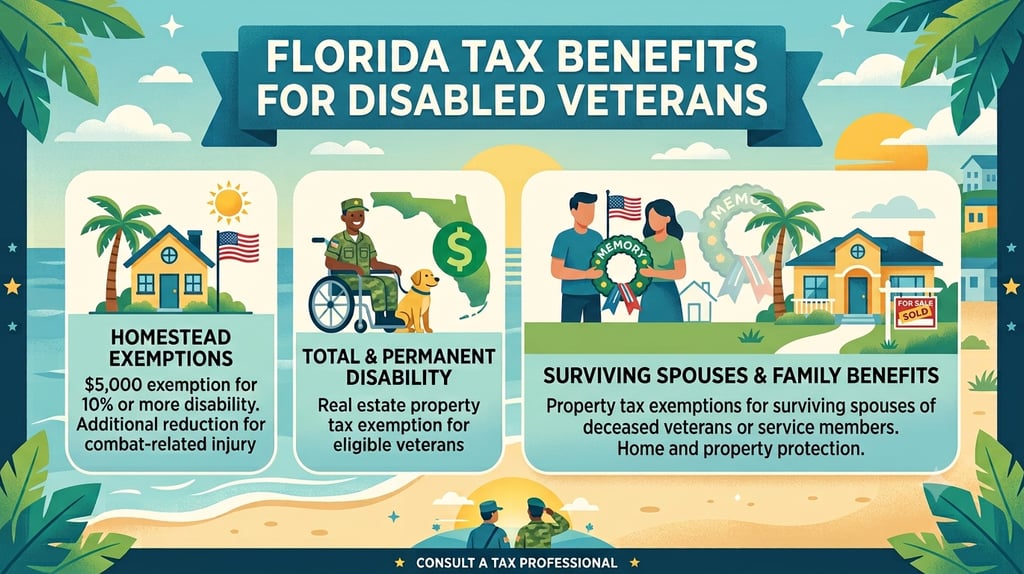
Any honorably discharged veteran who is a Florida resident and has a VA-rated service-connected disability of 10% or greater can claim an additional $5,000 reduction in the assessed value of their property (Florida Statutes § 196.24). This one is fairly easy to qualify for — the disability doesn't need to be combat-related — and unlike some of the other exemptions, it isn't limited to a homestead property. Depending on your local millage rate, this typically saves somewhere in the range of $50 to $100 a year, which is modest but is often combined with the other benefits described below.
Total and Permanent Disability: A Full Property Tax Exemption
This is the biggest benefit available, and it's a big one: veterans who are honorably discharged, are permanent Florida residents, and have a service-connected total and permanent disability certified by the VA can have their entire homestead property exempted from ad valorem (value-based) taxes (Florida Statutes § 196.081). In plain terms, that means no property tax bill on your primary home, aside from any non-ad valorem assessments like solid waste or stormwater fees that some counties charge separately.
To qualify, you'll need a letter from the VA certifying that your disability is total (100%) and permanent — meaning it renders you unable to engage in substantial gainful employment and is expected to last for the rest of your life. Veterans who are paraplegic, hemiplegic, or otherwise permanently and totally disabled and require the use of a wheelchair for mobility, as well as legally blind veterans, may also qualify for real estate tax relief under a related provision (Florida Statutes § 196.101), though that category can involve a household income test depending on the circumstances, so it's worth confirming the details with your county property appraiser.
Combat-Related Disability Discount for Veterans 65 and Older
Veterans who are age 65 or older, partially or permanently disabled, and were honorably discharged can receive a discount on their homestead property taxes equal to the percentage of their permanent, service-connected disability — as long as at least part of that disability is combat-related (Florida Statutes § 196.082). For example, a 65-year-old veteran with a 60% combat-related disability rating would see a 60% discount on their homestead's ad valorem tax bill. This exemption requires VA documentation that specifically identifies the disability as combat-related, not simply service-connected, so the paperwork here matters more than it does for the $5,000 exemption.
Benefits for Deployed Service Members
Current or former military members who were deployed outside the continental United States during a designated overseas operation in the previous calendar year can receive an additional exemption on their homestead, calculated as a percentage based on the number of days deployed during that year (Florida Statutes § 196.173). This one requires reapplying annually and documenting the specific deployment, so it's most relevant to veterans and service members who were on qualifying orders during the prior tax year.
Surviving Spouse Benefits
Florida law extends real protection to surviving spouses. In most cases, an un-remarried surviving spouse who holds legal or equitable title to the home and continues to use it as their permanent residence can carry forward the veteran's exemption — including the full total and permanent disability exemption. Separately, the surviving spouse of a service member who died from service-connected causes while on active duty may qualify for the total exemption independently, even if the veteran wasn't already receiving it. These benefits generally end if the spouse remarries or sells the property, though some portability protections may apply.
How and When to Apply
All of these exemptions are filed through your county property appraiser's office, generally using Form DR-501 (Form DR-501M for the deployed service member exemption). A few practical notes:
The application deadline for the current tax year is March 1. Many counties will still accept late applications for a period after that (often through mid-to-late fall) if you can show good cause, but it's best not to count on that.
Have your documentation ready before you apply: your DD-214 discharge paperwork, a current VA disability rating letter (or a letter specifically certifying total and permanent disability, where applicable), proof of Florida residency, and your homestead exemption paperwork if you haven't already filed it. If you're waiting on official VA documentation, most counties will let you submit your application and add the supporting paperwork once it arrives, with the exemption applied retroactively to your original application date.
Most of these exemptions renew automatically once granted, as long as your circumstances and homestead status don't change — but it's worth confirming this with your specific county appraiser's office, since local practices can vary slightly.
A Few Things to Keep in Mind
These exemptions generally stack — a veteran can hold the standard homestead exemption, the $5,000 disability exemption, and (if eligible) the combat-related discount at the same time. The total and permanent disability exemption is the exception in practice, since it already eliminates ad valorem taxes entirely, making the smaller exemptions moot for that particular tax bill.
It's also worth remembering that anything that jeopardizes your homestead status — renting out the home, establishing residency elsewhere, or claiming a homestead exemption on another property — can put these veteran benefits at risk too, since most of them require an active homestead exemption as a foundation.
Because exemption rules, forms, and local procedures can shift from year to year, and because eligibility can depend on the specific wording of your VA disability determination, it's a good idea to contact your county property appraiser's office directly before you apply, and to consult a tax professional or veterans service officer if your situation is at all complicated. This article is intended as a general overview and isn't a substitute for that kind of personalized guidance.
Sources: Florida Department of Revenue, Florida Department of Veterans' Affairs, Florida Statutes §§ 196.081, 196.082, 196.101, 196.173, 196.24, and county property appraiser offices (Miami-Dade, Palm Beach, and others).
☀️ Ready to take the next step toward the Sunshine State?
Reading articles is a great start, but packing up your life and moving to Florida requires a real roadmap. In my book, "The Florida Retirement Guide," I pull back the curtain on the actual costs, tax strategies, and regional realities you need to know to avoid expensive mistakes.
Plus, as a reader, you’ll get exclusive access to our online portal filled with downloadable planning charts, cost-of-living graphs, and moving timelines to make your transition smooth and stress-free.
© 2026 The Florida Retirement Guide
Unbiased Relocation Data
The Florida Retirement Guide
Helping you decide where and when to retire in Florida.