Healthcare in a Florida Retirement
This article discusses what healthcare in retirement looks like in Florida touching subjects such as Medicare, Medicare Advantage, hospital quality by region, and what retirees need to about long term care options in Florida.
HEALTHCARE
6 min read
Healthcare in Retirement: How Florida Really Stacks Up
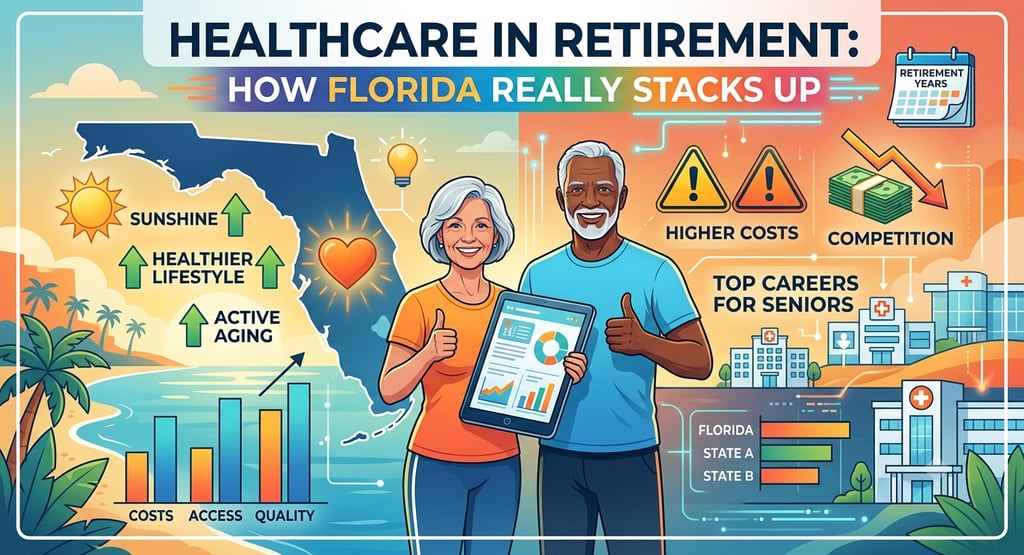
Ask ten people planning retirement what matters most and healthcare will make almost every list — usually right behind money, and often tangled up with it. Where you live determines which doctors you can see, how much you pay for Medicare coverage, how far you are from a hospital that can handle a real emergency, and what happens if you eventually need long-term care. Florida is the classic answer to "where should I retire," but the healthcare picture there is more layered than the postcard version suggests. Here's what retirement healthcare actually involves, and how the Sunshine State measures up.
What "healthcare in retirement" really means
For most retirees, healthcare costs come from a few different buckets:
Medicare premiums and out-of-pocket costs — Parts A, B, D, and either a Medigap policy or a Medicare Advantage plan
Day-to-day access — how easy it is to find a primary care doctor and specialists who take new Medicare patients
Hospital and specialty quality — where you'd go for a stroke, a cardiac event, or cancer treatment
Long-term care — assisted living, memory care, or nursing home costs, which Medicare barely touches
State-level factors — taxes, insurance markets, and cost of living, all of which affect how far your healthcare dollars stretch
Florida performs very differently across these categories, which is exactly why it's worth breaking apart rather than treating as one big "good" or "bad."
Where Florida wins
Medicare Advantage options are enormous. Florida has one of the largest Medicare populations in the country, with roughly 21–22% of residents 65 or older and well over 5 million Medicare beneficiaries statewide. That scale has pulled in insurers: Florida offered more than 600 Medicare Advantage plans for 2026, and virtually every Medicare-eligible resident has access to at least one $0-premium plan. More than half of Florida's Medicare beneficiaries — a notably higher share than the national average — are enrolled in Medicare Advantage rather than Original Medicare. If you want lots of plan choice, competitive extras (dental, vision, hearing, gym memberships, flex cards), and low nominal premiums, Florida delivers.
Major health systems have a real footprint. Retirees relocating to Florida aren't settling for small-town clinics. Mayo Clinic operates a full campus in Jacksonville, Cleveland Clinic has a significant Florida presence, and large academic and specialty centers are concentrated in Orlando, Tampa, and South Florida. For routine care and most specialty needs, access is genuinely strong.
No state income tax, no tax on Social Security. This doesn't lower your medical bills directly, but it matters for the same household budget that has to absorb Medicare premiums, supplemental insurance, and eventual long-term care costs. Florida is consistently ranked as one of the most tax-friendly states for retirees, and several 2026 comparisons rank it at or near the top nationally for retiree quality of life.
Nursing home staffing is a genuine bright spot. It's a detail few people check before moving, but Florida ranks near the top of the ten most populous states for nursing home staffing levels, requiring some of the highest direct-care hours per resident in the country. That's a meaningful quality signal in a sector where understaffing is a common problem nationally.
Where Florida struggles
Healthcare quality rankings are surprisingly mixed. This is the part that catches people off guard. Despite the sheer volume of providers, several major 2026 rankings — including analyses that weigh outcomes, access, and cost together — don't place Florida among the top-tier states for overall healthcare quality. High demand from such a large retiree population, combined with regional physician shortages, can mean longer wait times in some retiree-heavy areas, even with abundant facilities nearby.
Florida hasn't expanded Medicaid. Florida is one of about ten states that have not expanded Medicaid eligibility, which mainly affects lower-income residents under 65 rather than Medicare-age retirees directly — but it does reflect a broader pattern where states with more robust public health infrastructure (Massachusetts, Minnesota, Colorado) tend to score better on comprehensive healthcare rankings.
Long-term care is expensive, and it's rising fast. This is the number that should get the most attention, because it's the one people plan for least. A private nursing home room in Florida runs somewhere in the neighborhood of $100,000–$145,000 a year depending on the region, with costs climbing 3–5% annually. Assisted living is considerably cheaper — commonly cited between roughly $48,000 and $66,000 a year depending on location and room type — but still a major expense that Medicare essentially does not cover. Medicare pays for short-term skilled nursing after a hospital stay, capped at 100 days with a daily copay kicking in after day 20, and nothing beyond that. For long-term custodial care, Florida residents are largely on their own until they qualify for Medicaid, which has strict income and asset limits.
Insurance and cost-of-living pressure is real. Property insurance costs in Florida have risen sharply in recent years, and while that's not a "healthcare" line item, it competes for the same fixed retirement income that has to cover Medicare premiums and supplemental coverage.
How Florida compares to other popular retirement states
Arizona offers a similar retirement-hotspot profile — competitive Medicare Advantage plans and strong healthcare infrastructure in Phoenix and Scottsdale — with a drier climate as the differentiator.
North Carolina is increasingly mentioned as a rising alternative, with strong provider density around the Research Triangle and comparatively more affordable supplemental insurance options.
Texas offers broad insurance choice in its major metros but has real access gaps in rural areas.
Minnesota, home to the Mayo Clinic's flagship campus, regularly tops quality-focused rankings but comes with a much higher cost of living and harsher winters.
Wyoming and South Dakota edge out Florida in some composite retiree rankings largely on affordability, even though their healthcare infrastructure is thinner — a reminder that "best for retirees overall" and "best for healthcare specifically" aren't the same ranking.
The honest takeaway: Florida is rarely the single best state for healthcare quality, but it's consistently near the top for healthcare access and choice, which is a different — and for many retirees, more practical — thing to optimize for.
Questions worth answering before you commit
How does your specific county look? Medicare Advantage plan availability, hospital networks, and specialist access vary widely by ZIP code in Florida — what works in one part of the state may not work twenty miles away.
Do you want Medicare Advantage or Original Medicare plus Medigap? Florida's Medicare Advantage market is deep and often $0-premium, but if you split time between states or want the broadest possible provider access, Original Medicare with a supplement may suit you better, and Medigap rules and pricing vary by state.
What's your long-term care plan? This is the single biggest financial risk in retirement healthcare, in Florida or anywhere else. Long-term care insurance, a Medicaid spend-down strategy, or simply budgeting for it explicitly are all better than assuming Medicare will handle it — it largely won't.
Have you priced homeowners and flood insurance into your retirement budget? It's not healthcare, but it draws from the same pool of money.
The bottom line
Florida earns its reputation as a retiree-friendly state for real reasons: abundant Medicare Advantage choice, major health systems, no state income tax, and strong nursing home staffing standards. But it isn't a healthcare quality leader in the way some other states are, and its long-term care costs are substantial and climbing. The smartest approach isn't to ask "is Florida good for healthcare in retirement" as a yes-or-no question — it's to look at your specific county, your specific health needs, and your plan for the long-term care that Medicare won't cover, and decide from there.
This article is for general informational purposes and isn't personalized financial, legal, or medical advice. Medicare plan availability, costs, and Medicaid eligibility rules change annually — always verify current details for your specific county at Medicare.gov or with a licensed Florida SHINE counselor before making decisions.
Sources
Medicare.org, 2026 Medicare Advantage Plans in Florida by County
Owen Insurance Group, Medicare Advantage Plans in Florida: Enrollment, Costs, and Plan Options (2026)
SelectQuote, Medicare Advantage Plans in Florida for 2026
MedicareGuide.com, Which State Has the Best Healthcare for Retirees? (2026)
MoneyGeek, Best States for Health Care in 2026
Coastal Moving Services, States Ranked by Healthcare in 2026
The Motley Fool, 3 Best States to Retire (June 2026)
Plootus, Best States to Retire in 2026
Florida Health Care Association, Facts About Long Term Care in Florida
SeniorSite, Average Cost of Assisted Living in Florida (2026)
Nolo, When Medicaid in Florida Will Pay for a Nursing Home, Assisted Living, or Home Health Care (2026)
Zoecklein Law, Florida Nursing Home Costs 2026
☀️ Ready to take the next step toward the Sunshine State?
Reading articles is a great start, but packing up your life and moving to Florida requires a real roadmap. In my book, "The Florida Retirement Guide," I pull back the curtain on the actual costs, tax strategies, and regional realities you need to know to avoid expensive mistakes.
Plus, as a reader, you’ll get exclusive access to our online portal filled with downloadable planning charts, cost-of-living graphs, and moving timelines to make your transition smooth and stress-free.
© 2026 The Florida Retirement Guide
Unbiased Relocation Data
The Florida Retirement Guide
Helping you decide where and when to retire in Florida.