Exploring living in The Villages, Florida
This articles examines the pros and cons of living in The Villages, Florida
DESTINATIONSLIFESTYLECOST OF LIVING
8 min read
The Villages, Florida: An Honest Look at the Pros and Cons of Living There
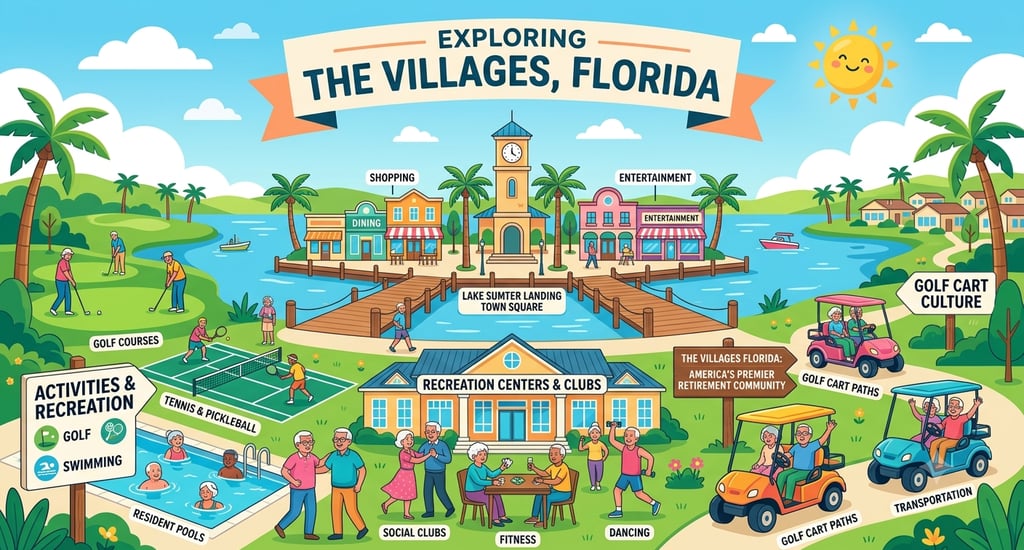
There is no place quite like The Villages. That sentence works as a compliment and as a warning, depending on who is saying it and why. Spread across parts of three counties in north-central Florida — Sumter, Marion, and Lake — The Villages has grown from a modest retirement subdivision in the 1970s into the largest retirement community in the United States and, by some measures, the fastest-growing metro area in the country for multiple years running. It now houses well over 130,000 residents, has its own ZIP codes, its own daily newspaper, its own television channel, its own radio stations, its own hospital, and a network of golf cart paths that stretches for hundreds of miles through a landscape of themed town squares, championship golf courses, and pastel-painted homes.
It is extraordinary and strange and genuinely worth understanding carefully before you decide whether it is right for you. Here is the honest version.
The Pros
The Infrastructure Is Genuinely Excellent
Whatever else you think of The Villages, the physical infrastructure is remarkable. The golf cart path system alone — over 750 miles of dedicated paths connecting virtually every neighborhood to every amenity — is an engineering and planning achievement that changes daily life in a concrete way. Residents routinely run errands, meet friends for dinner, attend concerts, and get to medical appointments without getting in a car. For people moving from suburban environments where a car is required for every single task, this is a genuine and meaningful quality-of-life improvement.
The amenities back this up. The Villages has over 50 golf courses (more than a dozen free "executive" courses and dozens of championship courses available to residents), hundreds of recreation centers, swimming pools, pickleball courts, tennis courts, softball fields, a polo club, a shooting sports complex, an equestrian center, and over 3,000 resident clubs covering everything from ballroom dancing to woodworking to beekeeping to political activism. The programming is constant and the participation rate is high. Boredom, as a practical matter, is genuinely difficult to sustain here if you are willing to engage.
The Cost Structure Works for Many Retirees
The Villages is not cheap — but the cost model is more transparent and, for many retirees, more favorable than alternatives. Home prices range from under $200,000 for older resale properties to over $700,000 for new construction in the newer districts, with the median resale around $350,000–$400,000. The monthly amenity fee (currently around $195–$215 per month depending on district) covers access to the golf cart paths, recreation centers, and most facilities. There is no country club membership required for the free executive golf courses.
Florida's tax environment adds to the equation: no state income tax, the homestead exemption reduces property taxes, and the Senior Exemption can reduce property taxes further for qualifying residents. For retirees on fixed incomes from Social Security, pensions, and investment accounts, the combination of amenity-rich living, a predictable fee structure, and a tax-friendly state makes The Villages a financially logical choice for a significant number of people.
The Social Life Is Real and Accessible
One of the most consistent things longtime residents say about The Villages is that the social isolation that threatens many retirees simply does not exist here if you make any effort at all. The structure of the community — the town squares with nightly free live entertainment, the club system, the recreation centers, the golf cart culture that makes spontaneous neighbor interaction constant — creates a social environment that can feel genuinely warm and communal.
For people who moved to The Villages from northern states where retirement often meant shrinking social circles, the contrast can be striking. The three town squares (Lake Sumter Landing, Brownwood Paddock Square, and Spanish Springs) each host free live entertainment every night of the year. Neighbors gather on golf carts. Clubs recruit members actively. The pace of social life here can be as full as anyone wants to make it, with built-in structure for people who struggle to find community on their own.
The Healthcare Access Has Improved Dramatically
The Villages Regional Hospital (now UF Health The Villages Hospital) opened in 2014 and has expanded significantly, bringing acute care, surgical services, cancer care, and specialist access directly into the community. The concentration of residents creates a market that attracts a wide range of medical practices, specialist offices, and healthcare services. For a community that skews elderly — the median age in Sumter County is in the mid-60s — this is not a trivial consideration.
The proximity to Gainesville (about 45 minutes north) gives residents access to UF Health's flagship academic medical center for complex cases, and to Ocala (about 20 minutes east) for additional hospital options. The healthcare infrastructure around The Villages is substantially better than it was a decade ago and continues to develop.
The Weather Window Is Real
The Villages sits in north-central Florida, somewhat inland, which gives it slightly more weather variation than the coasts. The winter season — roughly November through March — is genuinely pleasant: mild temperatures in the 50s to low 70s, low humidity, and abundant sunshine. The July–September heat and humidity is intense, but the infrastructure of The Villages (air-conditioned recreation centers, pools, indoor clubs) is designed around it. For people leaving the brutal winters of the Midwest, Northeast, or mid-Atlantic, the winters alone make a compelling case.
The Cons
It Is Not a Town — It Is a Private Development
This is the most important thing to understand about The Villages and the one most easily overlooked in the sales presentation. The Villages is not a city. It is a privately developed community controlled by the founding Morse family through a web of Community Development Districts (CDDs) and private entities. The town squares are privately owned. The amenity fee structure, the rules governing what you can do with your property, the architectural standards, the signage — all of this is governed by entities that are not subject to democratic accountability in the way a conventional municipality would be.
This is not theoretical. Residents have limited recourse when decisions are made that affect their daily lives. The CDDs levy assessments and their governance, while technically subject to election, functions in practice as an extension of the developer's interests. The "bond" — an infrastructure assessment included in the purchase price of new homes, typically $20,000–$50,000 — is a non-negotiable financial obligation that new buyers sometimes discover more fully after the sale than before it. Understanding what you are buying — a home in a private development with a specific governance structure — rather than what it looks like (a town) is essential preparation.
The Demographic Monoculture Is Real and Deliberate
The Villages qualifies as a 55+ community under the Housing for Older Persons Act (HOPA), which exempts it from the Fair Housing Act's prohibition on age discrimination. This means at least 80% of occupied units must have at least one resident who is 55 or older, and children under 19 cannot be permanent residents (short visits are permitted).
The result is a community that is not only overwhelmingly old but overwhelmingly white, overwhelmingly politically conservative, and overwhelmingly drawn from a specific socioeconomic band. This is a feature for many residents and a disqualifying characteristic for others. People who value age diversity, racial and ethnic diversity, or the presence of children and young families in their daily environment will not find those things here. People who actively prefer a homogeneous peer group will find exactly what they want. The honest assessment is simply: know what you are choosing.
The Isolation from the Broader World Is Structural
The Villages is designed to be self-contained, and it largely succeeds. Residents can and do go weeks without leaving the community. For many, this is the point. For others — particularly those with family or professional connections to the broader world, or those who simply value engagement with a diverse, multi-generational society — the isolation can feel less like refuge and more like removal.
The surrounding communities — Lady Lake, Leesburg, Wildwood, Fruitland Park — are small and not particularly vibrant. Gainesville and Orlando are the nearest cities of meaningful size, each about an hour away. If your life outside the golf cart path network matters to you, The Villages is relatively remote from it.
The Golf Cart Dependency Has Limits
The golf cart path network is genuinely impressive and functional for internal movement. But the community's rapid expansion — particularly into the newer districts south of US-27 — has outpaced the path network's coherence. Some residents in the newer southern sections find themselves more car-dependent than the promise implied. The paths are excellent; the community is also very large, and not all of it is equally connected.
Golf carts themselves are an ongoing expense: purchase ($8,000–$15,000+ for a new electric cart), maintenance, batteries (a significant replacement cost every 5–7 years), and insurance all add up. Residents who arrive expecting the golf cart lifestyle to eliminate car costs typically find it reduces but does not replace them.
The Amenity Fee and Bond Are Ongoing Financial Commitments
The monthly amenity fee (~$195–$215) is required regardless of how much you use the facilities. As the community ages and infrastructure requires replacement, the fee has the potential to increase. The bond assessment on new construction (which covers infrastructure costs) adds to the effective purchase price and accrues interest. Resale homes often have paid-off bonds, which is a genuine financial advantage over buying new.
Buyers who focus only on the home purchase price and undercount the ongoing amenity fee, bond (if applicable), CDD assessments, HOA fees (which vary by neighborhood), and the cost of golf cart ownership and maintenance can find the total monthly cost of living in The Villages considerably higher than their initial calculations suggested.
The Politics Are Intense
The Villages is one of the most politically active retirement communities in the country, and the politics run decidedly in one direction. During election cycles, the intensity of political activity — signage, golf cart parades, organized canvassing, town square conversations — can be overwhelming for residents who do not share the dominant political orientation. This has occasionally generated national news coverage during presidential election years.
This is not a reason to avoid The Villages if your politics align with the community majority. It is a reason to visit in an election year before deciding if you want to live there, if you are someone who finds that level of political intensity in daily residential life uncomfortable.
Hurricane and Storm Risk Is Real but Often Underestimated
Because The Villages is inland, its residents sometimes assume they are insulated from storm risk. This is partially true — storm surge does not reach here — but the community sits in a zone that receives significant impacts from tropical storms and hurricanes as they move inland. Hurricane Ian's remnants caused flooding and wind damage in the area in 2022. Property insurance in Florida, including in inland communities, has become significantly more expensive and difficult to obtain since 2022. The inland location reduces (not eliminates) risk, and the insurance cost reality should be part of any purchase analysis.
The Bottom Line
The Villages is extraordinary in the literal sense: there is nothing else quite like it in the world. For the specific person it is designed for — typically a healthy, active, financially stable retiree who wants a full social and recreational life in a structured, safe, predictable environment with an easy Florida winter climate — it delivers on its promise with remarkable consistency. The infrastructure is real. The amenities are real. The social life is real.
For people who value diversity — of age, race, politics, or life experience — it will feel limiting. For people who want to remain connected to the broader world rather than retreating from it, the self-containment will feel like restriction rather than refuge. For people who want to understand exactly who controls what they are buying into before they sign, the governance structure requires careful scrutiny.
The best advice is the same for The Villages as for anywhere else: visit during different seasons, talk to long-term residents (not just sales staff), read the CDD documents and the bond disclosures, and spend a week there before you commit. The people who love it tend to know, quickly, that they will. The people who would be unhappy there tend to notice the signs early, if they are paying attention.
This article is intended as an informational overview. Amenity fees, home prices, bond assessments, and community regulations change over time — verify all financial and legal details directly with The Villages before making any purchasing decision.
© 2026 The Florida Retirement Guide
Unbiased Relocation Data
The Florida Retirement Guide
Helping you decide where and when to retire in Florida.