Northeast Florida Local Guide
Jacksonville, St. Augustine, Ponte Vedra, Amelia Island, Gainesville, and the communities in between — what it's actually like to live here.
For residents and long-term visitors who want to go deeper than the beach or the theme parks.
Duval · St. Johns · Nassau · Alachua · Flagler • Real talk on costs • Local culture • Where locals actually go
The Vibe
Northeast Florida is the part of the state that feels most like the American South — and least like what most people picture when they think of Florida. Jacksonville is the largest city by land area in the contiguous United States, a sprawling, river-threaded port city with a passionate sports culture, a surprisingly deep music history, and a downtown that has been working hard at reinvention for two decades. St. Augustine is the oldest continuously occupied European settlement in the United States, a city of genuine historical weight surrounded by some of the best beaches in the state. Gainesville is a college town of unusual intellectual and cultural vitality anchored by the University of Florida. Amelia Island is one of the most beautiful and historically layered barrier islands in the South.
This region does not have the international glamour of Miami, the theme park gravity of Central Florida, or the retirement wealth of the Gulf Coast. What it has is authenticity, affordability relative to the rest of Florida, extraordinary natural beauty, a population that includes deep generational roots alongside rapid newcomer growth, and a pace of life that is neither rushed nor stagnant. The St. Johns River — one of the few rivers in North America that flows north — is the geographic and spiritual heart of the region in a way that is easy to underestimate until you live here.
Jacksonville
Riverside / Avondale
Vibe: Historic, walkable, the creative and dining core of Jacksonville
The most beloved neighborhoods in Jacksonville. Craftsman bungalows, tree-canopied streets, independent restaurants, coffee shops, galleries, and bars along King Street and Riverside Avenue. The Five Points intersection is the social hub. The St. Johns River runs along the southern edge. This is where Jacksonville's artists, young professionals, and longtime locals all converge. The median age is lower, the energy higher, and the walkability is the best the city offers.
San Marco
Vibe: Upscale, walkable village, Italian Renaissance architecture
San Marco Square is a beautifully preserved 1920s commercial district modeled on the Piazza San Marco in Venice. Independent boutiques, excellent restaurants, and a genuine neighborhood feel just south of downtown across the Fuller Warren Bridge. San Marco is where Jacksonville shows what it could be when it invests in its own history.
Downtown Jacksonville / Hemming Park
Vibe: Recovering urban core, riverfront, potential unrealized
Downtown Jacksonville has struggled with disinvestment for decades and remains a work in progress. But Hemming Park has been revitalized as a genuine public space. The Cummer Museum of Art and Gardens, the riverfront, the Landing area, and recent investments in the sports complex zone are generating real momentum. The Jaguars' new stadium development is reshaping the downtown landscape. Worth watching and worth visiting for what is already there — just go in with accurate expectations.
Springfield
Vibe: Historic, gritty-beautiful, genuine revitalization
Jacksonville's oldest neighborhood is in the midst of a genuine revival. Victorian-era homes on wide streets north of downtown, an arts community, and a DIY energy that is drawing younger residents priced out of Riverside. The Main Street corridor has new restaurants and bars. Springfield is the neighborhood that rewards people willing to look past the surface.
Beaches Communities — Jacksonville Beach, Neptune Beach, Atlantic Beach
Vibe: Surf town, laid-back, distinct from the city
The three beach towns on Jacksonville's Atlantic coast are effectively their own community — connected to the city by I-295 and Beach Boulevard but with a separate identity, social scene, and pace. Atlantic Beach is the quietest and most residential. Neptune Beach is the sweet spot of walkability and local character. Jacksonville Beach has the most nightlife and the most tourist traffic. All three have excellent surf and a genuine beach culture that is distinct from the Miami or Clearwater experience — more laid-back, more local, colder in winter.
Southside / Town Center
Vibe: Suburban commercial sprawl, national chains, practical
The commercial heart of Jacksonville's sprawling suburban landscape. St. Johns Town Center is the region's dominant shopping destination. The area has every national chain restaurant and retailer imaginable. It is not interesting but it is functional and central to how much of the Jacksonville population actually lives. Many residents find it works well as a base for access to both the beaches and the city core.
Mandarin / Julington Creek
Vibe: Established suburbs, family-oriented, riverside character
Mandarin is a historic community along the St. Johns River south of the city — Harriet Beecher Stowe lived here in the 1870s. Now a mature suburban area with good schools, riverside parks, and a quiet, established character. Julington Creek and the St. Johns County line communities to the south are among the fastest-growing areas in the entire state, driven by families seeking good schools and more space.
St. Augustine & St. Johns County
Historic Downtown St. Augustine
Vibe: 450+ years of history, walkable, tourist-heavy but genuinely extraordinary
The oldest city in the United States. The historic district, Castillo de San Marcos, St. George Street, the Colonial Quarter, and the bayfront are genuinely extraordinary in a way that rewards repeated visits. Yes, it is touristy — heavily so on weekends and in summer — but the bones of this city are unlike anywhere else in the country. Locals learn when to go (early weekday mornings, the shoulder season) and what to skip (the most crowded parts of St. George Street at peak hours). Living here means managing the tourist rhythm while having year-round access to something irreplaceable.
St. Augustine Beach / Vilano Beach
Vibe: Uncrowded, natural, community feel
St. Augustine Beach is a small, unpretentious beach community on Anastasia Island south of the historic district. More local than tourist, with good surf, a relaxed pace, and a farmers market on Saturday mornings. Vilano Beach, north of the historic district across the Bridge of Lions, is even quieter — a small island community with a handful of excellent restaurants and one of the most beautiful sunrise beaches in Northeast Florida.
Ponte Vedra Beach / Nocatee
Vibe: Affluent, golf-centric, planned community, TPC Sawgrass
Ponte Vedra Beach is home to TPC Sawgrass and the headquarters of the PGA Tour, and the golf culture permeates everything. Affluent, well-maintained, and with excellent beach access. Nocatee, just inland, is one of the largest master-planned communities in the US and one of the fastest-growing communities in Florida. Both are expensive relative to the rest of the region and cater to a demographic of affluent families and retirees.
Amelia Island & Nassau County
Fernandina Beach / Amelia Island
Vibe: Victorian charm, shrimping heritage, understated elegance
Amelia Island is the northernmost barrier island on Florida's Atlantic coast, just south of the Georgia border. Fernandina Beach has a beautifully preserved Victorian downtown — Centre Street is one of the most charming main streets in Florida — with a working shrimp boat fleet that has operated here since the late 1800s. The Ritz-Carlton Amelia Island anchors the south end of the island. The annual Isle of Eight Flags Shrimp Festival in May is the community's signature event. The pace here is deliberately unhurried.
Gainesville & Alachua County
Gainesville
Vibe: College town, intellectual, progressive, surprisingly affordable
Home to the University of Florida (one of the top public research universities in the US) and a significant medical complex anchored by UF Health. Gainesville has the intellectual energy, arts scene, and culinary ambition of a much larger city, constrained within a relatively small footprint. The Hippodrome Theatre, Civic Media Center, and a genuinely independent music scene reflect a cultural depth unusual for a city of 140,000. Housing is significantly more affordable than the coastal communities. The surrounding natural areas — Devil's Den, Ichetucknee Springs, Paynes Prairie — are extraordinary.
Flagler County
Palm Coast / Flagler Beach
Vibe: Planned community, quiet beach town, growing rapidly
Palm Coast is a large planned community that grew from a 1970s land sale development into one of the fastest-growing cities in Florida. Functional but lacking the character of its neighbors to the north and south. Flagler Beach, however, is a gem — a small, unpretentious beach town on A1A with a fishing pier, a handful of excellent local restaurants, and the kind of Old Florida character that is increasingly rare. The area between Daytona and St. Augustine along A1A through Flagler is one of the most beautiful coastal drives in the state.
Cost Realities
Northeast Florida is meaningfully more affordable than South Florida, the Gulf Coast, and even parts of Central Florida — and that affordability, combined with its quality of life, is driving significant population growth. The Jacksonville metro is one of the fastest-growing in the southeastern US, and prices have risen substantially since 2020, but the starting point was low enough that it remains a relative value within Florida.
Key Numbers
Rent (1BR) — Jacksonville: $1,300–$1,900/mo
Riverside and the beaches command the top of the range. Southside and the suburbs are more accessible. Jacksonville remains significantly below the state average for rent.
Rent (1BR) — St. Augustine / St. Johns County: $1,500–$2,300/mo
St. Johns County has seen dramatic price increases driven by its school district reputation and proximity to Jacksonville. The historic district itself is expensive for what you get. The surrounding county is growing fast and prices reflect it.
Rent (1BR) — Ponte Vedra / Nocatee: $1,800–$2,800/mo
The most expensive sub-market in the region outside of Amelia Island. Golf course and gated community living carries a premium.
Rent (1BR) — Gainesville: $950–$1,500/mo
The most affordable major market in Northeast Florida, reflecting the college-town economy. Student housing supply helps keep overall costs down. A genuine value for non-student residents.
Rent (1BR) — Amelia Island / Fernandina Beach: $1,600–$2,400/mo
Island living carries a premium relative to the Nassau County mainland. Seasonal rental demand pushes short-term rates significantly higher.
Groceries: Near or slightly below national average
Publix is the dominant chain throughout. Aldi and Winn-Dixie for budget. Trader Joe's in Jacksonville and Gainesville. Fresh Market in Ponte Vedra and San Marco. Local farm stands particularly strong in Alachua County.
Dining out: $12–18 for a casual lunch
Jacksonville is genuinely affordable compared to South Florida. St. Augustine tourist-zone restaurants run higher. Gainesville has exceptional food value given the college-town competition.
Gas: At or slightly below national average
Jacksonville's sprawl means significant driving. The city's size (874 square miles) means commutes are real. Budget for fuel accordingly.
Electric bill: $110–190/month
JEA (Jacksonville Electric Authority) serves Duval County. FPL and Duke Energy in surrounding counties. Less extreme than South Florida but A/C runs most of the year.
Things to Know
St. Johns County schools drive the real estate market
St. Johns County has one of the highest-rated public school systems in Florida, consistently ranking among the top counties statewide. This reputation drives significant family migration from Duval County and beyond, and it is a primary reason why communities like Nocatee, Ponte Vedra, and the World Golf Village area carry housing premiums. For families with school-age children, the school district calculus is often the single most important factor in where they choose to live in this region.
Jacksonville's size is a genuine cost factor
At 874 square miles, Jacksonville is the largest city by area in the contiguous US. This means that a commute of 20 miles is not unusual, and that residents in the beach communities, Mandarin, or the Southside are effectively living in different cities from a practical standpoint. Factor commute distance and fuel cost into any housing decision.
Insurance is significant but less extreme than South Florida
Property insurance in Northeast Florida is elevated above the national average due to hurricane and tropical storm risk, but it is meaningfully less extreme than in South Florida or the Gulf Coast. Northeast Florida has not taken a direct major hurricane hit in decades, which keeps actuarial risk — and therefore premiums — lower. Homeowners can generally expect $2,000–4,500/year depending on location and structure.
The no-income-tax advantage
Florida's absence of state income tax is a consistent draw for relocators from Georgia, the Carolinas, and the Northeast. Combined with Northeast Florida's lower housing costs, the effective purchasing power here is higher than the raw numbers suggest for middle- and upper-income earners.
Rapid growth is changing prices fast
The Jacksonville metro area and St. Johns County in particular are growing at rates that make price data go stale quickly. The 2020–2024 period saw rent increases of 30–60% in some submarkets. The pace has moderated but the direction is upward. Budget conservatively and verify current prices directly.
Weather — The Honest Version
Northeast Florida has the most genuinely four-season climate in Florida — which means actual winters (occasional freezes, genuine cold fronts) alongside the subtropical summers the rest of the state experiences. For people from northern states, this is often a pleasant surprise. For people from South Florida, the winters here feel jarring.
Dec – Feb: Winter (38–68°F)
Northeast Florida gets real cold fronts. Temperatures can drop to the low 30s overnight, with freezes occurring several times per year. The Atlantic Ocean moderates temperatures at the beaches, but inland areas (Gainesville, western Jacksonville) can see hard freezes. Days are often beautiful — clear, crisp, low humidity — but you will need a jacket, sometimes a real coat. This is the season that separates Northeast Florida from the rest of the state and why it attracts a different kind of resident.
Mar – May: Spring (60–82°F)
One of the most pleasant seasons in the region. Mild temperatures, low humidity, and the live oaks leafing out. Azalea season in late February through March is spectacular — particularly in Riverside, San Marco, and the St. Augustine historic district. Spring in Northeast Florida is genuinely beautiful and the best time to explore the region for the first time.
Jun – Sep: Summer (88–95°F)
Hot, humid, and prone to afternoon thunderstorms — the standard Florida summer pattern. The Atlantic beaches provide more breeze than the Gulf Coast and water temperatures are warm but not as bath-like as the Gulf. Humidity is high but the evenings are more bearable than further south. Hurricane season runs June through November with northeast Florida facing genuine risk — particularly from storms tracking up the coast.
Oct – Nov: Fall (60–82°F)
The secret best season. Humidity drops, temperatures ease, the tourist traffic in St. Augustine thins, and the region's natural areas — the river, the beaches, the state parks — are at their most accessible and beautiful. Actual fall foliage is minimal (Florida is subtropical) but the light changes and the air quality in October and November is exceptional.
Hurricane risk in Northeast Florida is real but different from the Gulf Coast. The dominant threat is from storms tracking northward along the Atlantic Coast or cutting across the state from the Gulf. The 2004 hurricane season brought multiple storm impacts to the region. Matthew (2016) caused significant coastal erosion and flooding in St. Augustine and the beaches. Idalia (2023) brought impacts further north. Coastal flooding, particularly in the historic St. Augustine waterfront and the beach communities, is the primary concern during storm events.
Daily Conveniences
Groceries & Markets
Publix
The dominant chain throughout the region. Well-stocked and reliable. GreenWise Market locations in Jacksonville and St. Johns County carry expanded natural and organic selections. The Pub Sub remains a Florida institution.
Aldi
Expanding rapidly throughout Northeast Florida and offers the best value for dry goods, produce, and dairy. A genuine budget option that locals rely on heavily for staples.
Trader Joe's
Locations in Jacksonville (Mandarin area and St. Johns Town Center area) and Gainesville. Popular with the under-40 demographic and the college community. Worth the trip for specialty items and their private-label wines and foods.
Winn-Dixie
Present throughout the region. Budget-friendly and reliable for staples. The meat departments are often underrated.
Wards Supermarket — Gainesville
A local Gainesville institution with multiple locations. More affordable than Publix, more full-service than Aldi. Beloved by longtime Gainesville residents for its produce and local character.
Beaches Local Farmers Markets
The Beaches Green Market operates Saturday mornings at Jarboe Park in Neptune Beach — excellent local produce, honey, prepared foods, and plants. The Riverside Arts Market (Jacksonville) operates Saturday mornings under the Fuller Warren Bridge with local art, food, and produce vendors. The St. Augustine Amphitheatre Farmers Market on Saturday mornings is one of the best in Northeast Florida.
Getting Around
Northeast Florida is car-dependent, but Jacksonville's Skyway (an automated people mover) and the JTA bus system provide limited urban options. The region's size and sprawl make a car essential for most daily needs.
• JTA (Jacksonville Transportation Authority) operates bus routes throughout Duval County and the Skyway downtown connector, but service is infrequent and coverage limited.
• The Skyway — Jacksonville's automated downtown people mover — is free and connects key downtown points, but its coverage is very limited.
• The St. Johns River Ferry connects Mayport to Fort George Island — a beloved local institution and a scenic shortcut for beach-area residents heading north.
• I-95 is the main north-south spine. I-295 is the outer beltway. Both get congested during rush hour and summer weekends.
• A1A along the coast is the scenic alternative to I-95 between Jacksonville and Daytona — beautiful, slow, and worth taking when time allows.
• Gainesville Regional Transit System (RTS) is useful for UF students and campus-area residents. Coverage is reasonable within the city core.
• SunPass is useful for I-95 express lanes in Jacksonville.
Healthcare
UF Health Jacksonville (formerly Shands Jacksonville) is the major academic medical center and Level I trauma center for the region, affiliated with the University of Florida. Mayo Clinic has a significant campus in Jacksonville — one of only three Mayo locations in the US and a major asset for the region's healthcare quality. Baptist Health and Ascension St. Vincent's are the dominant private systems with multiple hospitals throughout the Jacksonville area. UF Health Gainesville, connected to the UF College of Medicine, is one of the premier academic medical centers in the southeastern US and a major draw for complex case patients from throughout the region.
Education
The University of Florida in Gainesville is a flagship public research university consistently ranked in the top 10 nationally among public universities. Jacksonville University, Florida State College at Jacksonville (FSCJ), and University of North Florida (UNF) serve the Jacksonville community. Flagler College in St. Augustine is a small liberal arts college with a beautiful campus in a historic building (the former Ponce de León Hotel). The St. Johns County school district is consistently rated among the top public school systems in Florida and drives significant family migration to the area.
Local Eats Worth Knowing
Northeast Florida's dining scene is often underestimated. Jacksonville has developed a genuinely impressive food culture over the past decade, anchored in Riverside and San Marco with outposts throughout the metro. St. Augustine's tourist economy supports more restaurants per capita than the population would suggest. Gainesville's college community drives an eclectic, affordable, and often excellent food scene. Amelia Island punches well above its small size.
Jacksonville
Intuition Ale Works — Springfield
Craft brewery + food · $ · Jacksonville beer institution
The brewery that anchored Jacksonville's craft beer scene. IPA fans make pilgrimages here for the People's Pale and the King Street Stout. The Springfield taproom has a food truck presence and a genuine community feel. More than a brewery — a cultural institution.
Biscottis — Avondale
American bistro · $$ · neighborhood icon
A beloved Avondale institution that has been drawing locals for decades. Creative sandwiches, excellent salads, and one of the best weekend brunch scenes in the city. The outdoor patio under the live oaks is quintessential Jacksonville. Consistently excellent and unpretentious.
Orsay — Riverside
French-American · $$$ · the anchor of Jacksonville fine dining
The benchmark against which other Jacksonville restaurants measure themselves. French bistro technique applied to Southern and American ingredients. The steak frites, sweetbreads, and rotating seasonal menu are consistently excellent. Small room, excellent wine list, warm service. Reserve ahead.
The Bearded Pig — San Marco
BBQ · $$ · wood-smoked and serious
Jacksonville's finest barbecue. Brisket, pulled pork, and ribs smoked low and slow over local wood. The sides are thoughtful and the craft beer list is well-curated. Long lines on weekends; arrive early or accept the wait. Worth it.
Hawkers Asian Street Fare — Riverside
Pan-Asian street food · $$ · lively
A local concept (founded in Orlando) with a strong Jacksonville presence. Roti canai, laksa, char kway teow, and other Southeast Asian street food classics done well at accessible prices. Loud, fun, and reliably excellent.
Safe Harbor Seafood — Mayport / Atlantic Beach
Seafood · $ · straight from the docks
Mayport is a working fishing village at the mouth of the St. Johns River and Safe Harbor is its restaurant — simple, fresh, and direct. Shrimp, grouper, flounder, and crab caught locally and served without pretension. The shrimp basket is the move. Go early.
Whiteway Deli — Riverside
Deli / Jewish deli · $ · a Jacksonville original
One of Jacksonville's oldest continuously operating restaurants, a Jewish deli that predates most of the modern dining scene by decades. The matzo ball soup, corned beef on rye, and egg salad are the classics. A piece of Jacksonville history that is still very much alive.
St. Augustine
The Floridian — Historic District
Florida-local cuisine · $$ · farm-to-table pioneer
A restaurant that changed St. Augustine's dining scene when it opened by insisting on local sourcing and seasonal cooking. The Floridian breakfast and lunch are exceptional — shrimp and grits, local fish preparations, vegetable-forward dishes. Weekend waits are long; arrive early or accept them as part of the experience.
Columbia Restaurant — St. Augustine
Spanish/Cuban · $$ · historic institution
A branch of the Tampa original, housed in a beautiful space in the historic district. Not as legendary as the Ybor City mother ship, but genuinely excellent for Cuban-Spanish food in an extraordinary setting. The 1905 Salad tableside and the Cuban sandwich are the anchors.
Preserved — Historic District
New American · $$$ · St. Augustine's finest
The most celebrated restaurant in St. Augustine proper. A seasonally driven menu with excellent sourcing, a beautiful intimate room, and a wine list that takes the dining seriously. For a special meal in St. Augustine, this is the destination.
Catch 27 — Historic District
Florida seafood · $$ · local catch focused
Named for Florida's latitude, Catch 27 focuses on what's coming off Florida's docks. The fish sandwich on house-baked bread and the local grouper preparations are the standouts. A more casual alternative to Preserved that delivers genuinely excellent fish.
Scarlett O'Hara's — Cordova Street
Southern / pub · $ · local institution in a Victorian house
A Victorian house turned restaurant and bar that feels like a genuine St. Augustine institution rather than a tourist construct. Southern comfort food, cold beer, live music on weekends, and a porch that captures the old city's character beautifully.
Gainesville
Satchel's Pizza — Gainesville
Pizza · $ · a genuine cult classic
One of the most famous independent pizza restaurants in Florida. Satchel's is an experience as much as a meal — the eclectic garden setting, the owner's personality embedded in everything, and the pizza itself (thin-crust, well-topped, perfectly executed). The wait can be long; the BYO policy and garden atmosphere make it bearable. A Gainesville pilgrimage.
Emiliano's Café — Downtown Gainesville
Latin fusion · $$ · lively downtown institution
A lively downtown restaurant with a Latin soul and a wide-ranging menu that moves from Cuban to Mexican to nuevo Latino with genuine skill. The mojitos are excellent and the paella is worth ordering. One of the most reliable dinner destinations in Gainesville.
Dragonfly Sushi — Gainesville
Japanese · $$ · excellent and affordable
Far better than you might expect from a college town sushi restaurant. Creative rolls, excellent nigiri, and a lively bar scene. The happy hour deals are among the best food values in Northeast Florida.
Hogan's Heroes — Gainesville
Subs / sandwiches · $ · a UF institution
The definitive Gainesville sub shop, feeding students and locals for decades. The Italian sub and the turkey and avocado are the go-to orders. Cheap, generous, and perfectly executed. Cash-forward and proudly old-school.
Amelia Island / Fernandina Beach
Brett's Waterway Café — Fernandina Beach
American seafood · $$ · marina setting
Consistently excellent waterfront dining on the Amelia River. Fresh local shrimp (Fernandina's shrimp fleet is one of the last working shrimp fleets in Florida), good fish, and a setting that captures the maritime character of Fernandina beautifully.
29 South — Fernandina Beach
Southern fine dining · $$$ · Centre Street gem
The most acclaimed restaurant on Amelia Island. A seasonal menu rooted in Low Country Southern cooking with genuine culinary ambition. The pimento cheese, shrimp and grits, and rotating catch preparations are benchmarks. Reserve well ahead in season.
Northeast Florida's most underappreciated food category: the shrimp. Mayport shrimp — caught in the Atlantic off Jacksonville's coast — and Fernandina shrimp are among the sweetest wild-caught shrimp available in the US. At Safe Harbor in Mayport or Brett's in Fernandina, you are eating shrimp that came off the boat that morning. This is a genuinely special thing that gets almost no national attention.
The Fun Stuff (Locals' Edition)
Northeast Florida rewards exploration. The combination of the oldest city in the US, the St. Johns River, Atlantic beaches, freshwater springs, and one of the great state parks systems in the country gives this region a range of experiences that is genuinely difficult to exhaust.
Castillo de San Marcos — St. Augustine
National Monument · ticketed · extraordinary
The oldest masonry fortification in the continental United States, built by the Spanish beginning in 1672 from coquina — a local shell-stone that absorbs cannon fire rather than shattering. The fort is remarkably intact and the history it represents — Spanish, British, and American colonial periods, Civil War, and beyond — is layered and extraordinary. Go early morning to have it largely to yourself. The view of the Matanzas Bay from the gun deck is one of the best in Northeast Florida.
Cummer Museum of Art & Gardens — Jacksonville
Ticketed · world-class collection · river gardens
One of the finest small art museums in the southeastern US. The permanent collection spans antiquity to the contemporary, with a particularly strong holdings in American art and Meissen porcelain. The formal gardens along the St. Johns River are immaculate and free to wander on certain days. A gem that Jacksonville locals are rightly proud of.
Ichetucknee Springs State Park — near Gainesville
Ticketed · tubing · one of Florida's great experiences
The Ichetucknee River runs through a series of crystal-clear springs and offers one of the most joyful Florida experiences available — floating on a tube through spring-clear 68°F water under cypress trees. The springs are open for tubing June through Labor Day. The paddle launch points offer kayaking year-round. This is Florida at its most primordial and beautiful. The park limits daily visitors to protect the springs; arrive early or reserve ahead.
Little Talbot Island State Park — Nassau County
Ticketed · pristine barrier island · camping available
One of the few remaining undeveloped barrier islands on Florida's Atlantic coast. Long, wide, windswept beach with dunes and maritime forest. Exceptional shelling, birdwatching, and camping. The contrast with the developed beach communities nearby is striking. This is what the coast looked like before the condos.
Paynes Prairie Preserve State Park — Gainesville
Ticketed · bison, wild horses, and alligators · extraordinary wildlife
A vast wet prairie south of Gainesville that was once a lake (William Bartram described it in 1774) and now supports one of the most remarkable wildlife assemblages in Florida — American bison, wild horses, sandhill cranes, and enormous alligators. The La Chua Trail at the park's north end is one of the best wildlife walks in the southeastern US. In winter, sandhill cranes gather in enormous flocks at sunset.
St. Johns River by Boat or Kayak — Jacksonville
Free / rental · the heart of the city
The St. Johns River flows through the heart of Jacksonville and is the defining feature of the landscape. Kayaking from downtown along the river, taking a water taxi between the San Marco shore and downtown, or simply watching the river traffic from the Riverside riverfront are daily pleasures that residents take for granted and visitors underutilize. The river at sunset from the Main Street Bridge is one of Jacksonville's most beautiful sights.
Florida Georgia Line (The Game) — Jacksonville
Annual · late October · Jacksonville's biggest event
The Florida-Georgia college football game, played annually at TIAA Bank Field in Jacksonville, is one of the great spectacles in college football and the biggest annual event in Northeast Florida. Over 80,000 fans, tailgating that begins days in advance, and an atmosphere that is genuinely unlike any other college football weekend. Jacksonville claims it as its own tradition. If you live here, you experience it — whether you want to or not — because the entire city is involved.
Devil's Den Spring — Williston (near Gainesville)
Ticketed · underground spring · snorkeling and diving
A prehistoric underground spring inside a sinkhole — essentially a cave that has collapsed to reveal a clear blue pool accessible by wooden stairs. Snorkeling and scuba diving in a 72°F underground spring with fossil bones visible in the walls. One of the most surreal natural experiences in Florida and not widely known outside the region.
Riverside Arts Market — Jacksonville
Free · Saturday mornings · under the Fuller Warren Bridge
A beloved weekly market under the Fuller Warren Bridge in Riverside with local artists, food vendors, live music, and a community energy that represents Jacksonville at its most genuinely creative. The market runs year-round Saturday mornings and is the best free thing in Jacksonville. Bring cash.
Fort Clinch State Park — Fernandina Beach
Ticketed · Civil War fort · exceptional beaches
A remarkably intact Civil War-era brick fort at the north tip of Amelia Island, surrounded by a state park with some of the most beautiful and least crowded beaches in Northeast Florida. Rangers in period costume conduct living history demonstrations on weekends. The view north to Cumberland Island, Georgia from the fort's walls is extraordinary.
Things No Tourist Brochure Will Tell You
Jacksonville is the South, not just Florida
Northeast Florida has a Southern cultural identity that distinguishes it from Miami, Tampa, and Orlando. College football (Gators and Jaguars), Southern food traditions, a strong military presence (NAS Jacksonville, Naval Station Mayport, Camp Blanding), and a political landscape that runs more conservative than the I-4 corridor. This is not a criticism — it is context. People who move here from other parts of Florida are sometimes surprised by how different the culture feels.
The music history is real and underappreciated
Jacksonville produced Lynyrd Skynyrd, Tom Petty (Gainesville), Molly Hatchet, .38 Special, and a significant chapter in Southern rock history. The Jacksonville music scene of the early 1970s was one of the most fertile in the American South. That legacy is still felt in the city's relationship to live music and in annual events like the Tom Petty Birthday Bash and the Free Bird tribute culture that permeates the Riverside bar scene.
St. Augustine flooding is a serious issue
The historic district of St. Augustine floods regularly during king tides (the highest tidal events of the year) and storm events — even without a hurricane. The combination of sea level rise, the low-lying waterfront location, and the city's age makes flooding a structural issue that residents and property owners navigate constantly. If you are buying property in St. Augustine, understand the flood history and elevation certificate of your specific property.
The Mayport Naval Station shapes the community
Naval Station Mayport is one of the largest naval installations on the East Coast and its presence shapes the Atlantic Beach and Mayport communities economically and culturally. The military community — active duty, veterans, and contractors — is a significant and distinctive part of the Northeast Florida demographic. The turnover of military families creates a rental market with specific characteristics and a community that is both transient and deeply rooted simultaneously.
Gainesville in summer is a different place
When the University of Florida's 60,000+ students leave for the summer, Gainesville's population and energy drop noticeably. Restaurants get quieter, traffic eases, and the city's pace slows considerably. For permanent residents, summer Gainesville is either a relief or a dead period depending on your orientation. The flip side: fall move-in week in August is chaotic, and football Saturdays in the fall transform the entire city.
The springs are the real Florida
Within two hours of most Northeast Florida locations, there are more than 30 freshwater springs — constant 68–72°F, crystalline, and ecologically extraordinary. Ichetucknee, Silver Springs, Silver Glen, Alexander Springs, Blue Spring (near Daytona), and Devil's Den are the highlights. These springs are genuinely among the most beautiful natural environments in the eastern United States and they are dramatically underutilized by Florida residents who live near them. Go in summer when the 72°F water is blissful; go in winter to swim with manatees at Blue Spring.
A1A is one of America's great drives
Florida State Road A1A runs along the Atlantic coast from Fernandina Beach south through Jacksonville Beach, Ponte Vedra, St. Augustine, and on to Daytona and beyond. Through Northeast Florida, it passes through some of the most beautiful and varied coastal landscapes in the state — undeveloped barrier islands, salt marshes, historic bridges, and small beach towns that have resisted development. The drive from Fernandina to St. Augustine on A1A, with time to stop at Little Talbot Island and Washington Oaks Gardens State Park, is one of the great Florida road trip segments.
The St. Johns River flows north
This geographical curiosity is worth knowing: the St. Johns River, which drains a vast watershed of Central and Northeast Florida before emptying into the Atlantic at Mayport, flows northward — one of the few rivers in North America to do so. This has historically created confusion for newcomers and a point of quiet pride for locals. The river's character — wide, dark-tannic, lined with cypress and Spanish moss — is distinctly different from the clear springs and Gulf-facing rivers of other Florida regions, and it gives Jacksonville a landscape identity unlike any other Florida city.
Northeast Florida Local Guide
Duval · St. Johns · Nassau · Alachua · Flagler
For residents and long-term visitors
Always verify hours and prices before visiting
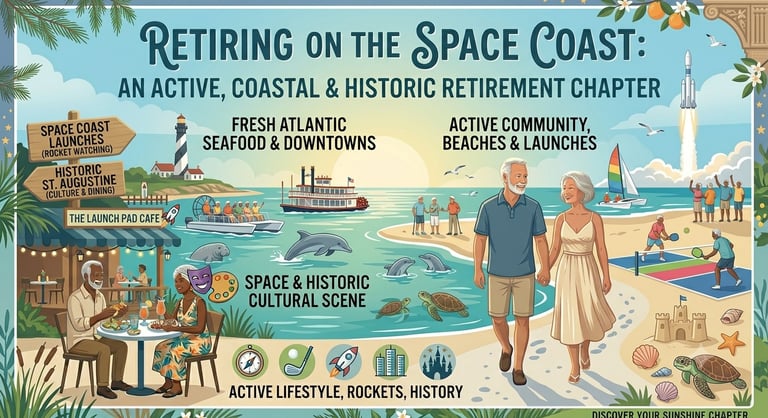
The Space Coast
(Northeast Florida)
☀️ Ready to take the next step toward the Sunshine State?
Reading articles is a great start, but packing up your life and moving to Florida requires a real roadmap. In my book, "The Florida Retirement Guide," I pull back the curtain on the actual costs, tax strategies, and regional realities you need to know to avoid expensive mistakes.
Plus, as a reader, you’ll get exclusive access to our online portal filled with downloadable planning charts, cost-of-living graphs, and moving timelines to make your transition smooth and stress-free.
© 2026 The Florida Retirement Guide
Unbiased Relocation Data
The Florida Retirement Guide
Helping you decide where and when to retire in Florida.