Northwest Florida Local Guide
Pensacola, Destin, Panama City Beach, Fort Walton Beach, 30A, Tallahassee, and the communities of the Florida Panhandle — what it's actually like to live here.
For residents and long-term visitors who want to understand the Panhandle beyond the spring break headlines.
Escambia · Santa Rosa · Okaloosa · Walton · Bay · Leon • Real talk on costs • Local culture • Where locals actually go
The Vibe
Northwest Florida — the Panhandle — is geographically and culturally the most distinct region in the state. It shares more in common with Alabama, Mississippi, and Georgia than it does with Miami or Orlando. The accents are Southern. The food is Southern. The politics are deeply Southern. The military presence is enormous — Eglin Air Force Base, Hurlburt Field, NAS Pensacola, Tyndall Air Force Base, and Naval Air Station Whiting Field collectively make this one of the most significant military corridors in the country. And layered over all of this is some of the most spectacular coastline in the United States: the sugar-white quartz sand and emerald-green water of the Gulf of Mexico from Pensacola to Panama City Beach is genuinely among the most beautiful in the world, and locals know it even when they are tired of the tourists who confirm it.
The Panhandle is also two very different Floridas in close proximity. The coast — Destin, 30A, Panama City Beach, Pensacola Beach — is driven by tourism, real estate, and military adjacency. The interior — Crestview, DeFuniak Springs, Chipley, Marianna — is rural, agricultural, and largely untouched by the coastal economy. Tallahassee, the state capital, sits at the eastern edge of the Panhandle and is its own world: a government and college town of genuine political importance and surprising cultural depth. Understanding the Panhandle means understanding that all of these places exist simultaneously and are not always talking to each other.
Pensacola & Escambia County
Downtown Pensacola / Palafox Street
Vibe: Historic, walkable, arts-forward, revitalized
Palafox Street is the spine of downtown Pensacola and one of the most genuinely pleasant main streets in the Panhandle. Victorian and early 20th-century commercial architecture, independent restaurants and bars, the Saenger Theatre, galleries, and a public market. The Friday Night Block Party on Palafox draws locals year-round. Pensacola has invested seriously in its downtown and the result is a walkable, livable urban core that feels earned rather than manufactured.
East Hill / North Hill — Pensacola
Vibe: Historic residential, craftsman bungalows, neighborhood feel
The established residential neighborhoods north and east of downtown. North Hill is a historic district of Victorian homes on wide, canopied streets — one of the most beautiful residential neighborhoods in the Panhandle. East Hill is similar in character, slightly more eclectic, with a growing restaurant and coffee shop scene along 9th Avenue. These neighborhoods have the walkability and character that most of the Panhandle lacks.
Pensacola Beach
Vibe: Resort beach community on Santa Rosa Island, barrier island living
Pensacola Beach sits on Santa Rosa Island, a barrier island accessible by the Bob Sikes Bridge. The beach here — white quartz sand, clear emerald water — is extraordinary. Living on the island is a lifestyle choice with real tradeoffs: limited grocery access, bridge traffic on weekends, and a leasehold land situation unique to Pensacola Beach (most land is leased from Escambia County rather than owned outright, which affects mortgage and insurance options). The community is tight-knit and the sunsets are exceptional.
Navarre Beach
Vibe: Quieter, more residential, the locals' alternative to Pensacola Beach
Navarre Beach on Santa Rosa Island east of Pensacola Beach is consistently less crowded, less developed, and more affordable than its neighbor. The pier is one of the longest fishing piers on the Gulf Coast. Military families from Hurlburt Field and Eglin make up a significant portion of the community. A genuine alternative to the tourist-heavy beach markets.
Fort Walton Beach, Destin & Okaloosa County
Destin
Vibe: Tourism-dominant, deep-sea fishing capital, high-density coastal development
Destin calls itself the "World's Luckiest Fishing Village" and the deep-sea fishing charter business here is genuinely among the best on the Gulf Coast — the Destin Harbor fleet is one of the largest private fishing fleets in the country. The beaches are beautiful. The traffic on US-98 in summer is a genuine quality-of-life issue. Destin has developed intensely and the result is a place that can feel overwhelmed by its own success during peak season. Locals learn the back roads and the off-season.
Fort Walton Beach
Vibe: Military-adjacent, more local than Destin, underrated dining scene
Fort Walton Beach sits in the shadow of Destin but has a more local, less tourist-driven character. The proximity to Eglin Air Force Base and Hurlburt Field gives the community a strong military identity. The downtown and waterfront have a genuine neighborhood feel. Prices are meaningfully lower than Destin for housing and dining. Many military families choose Fort Walton Beach for its sense of community and affordability.
Niceville / Valparaiso / Bluewater Bay
Vibe: Quiet, suburban, Eglin-adjacent, good schools
Niceville and Valparaiso are the suburban communities immediately north of Fort Walton Beach and east of Eglin AFB. The Okaloosa County school system — particularly Niceville High School — is consistently rated among the best in Florida. Bluewater Bay is a well-maintained planned community on a bay with good amenities. These communities attract military families and professionals who want good schools and a quieter pace than the beach towns.
30A — South Walton
Seaside / Watercolor / Rosemary Beach / Alys Beach
Vibe: New Urbanist planned communities, high design, premium pricing, The Truman Show was filmed here
County Road 30A is a 24-mile scenic highway through a series of planned coastal communities in South Walton County that has become one of the most desirable addresses in the Southeast. Seaside was the first New Urbanist community in the US (planned 1981, completed over decades) and was used as the set for The Truman Show. The communities along 30A — Seaside, WaterColor, WaterSound, Rosemary Beach, Alys Beach — share a commitment to walkability, architectural coherence, and proximity to the beach that has created some of the most sought-after and expensive real estate in the Panhandle. The beaches here are extraordinary. The prices are not modest.
Grayton Beach / Blue Mountain Beach
Vibe: Original 30A, funky, more affordable than its neighbors, artist community
Grayton Beach is the original beach community on 30A — a scrappy, bohemian predecessor to the planned communities that came after it. The Red Bar is a local institution. Blue Mountain Beach, just west, sits at the highest elevation on the Gulf Coast (64 feet above sea level — modest by most standards, remarkable for the Gulf Coast). Both have a more relaxed, less polished character than Seaside and Alys Beach.
Panama City Beach & Bay County
Panama City Beach
Vibe: Spring break capital of the South, high-density resort, recovering from Hurricane Michael
Panama City Beach has a reputation primarily as a spring break destination and the reality is not far from the reputation during March. But the beach here is genuine — the same white quartz sand and green water as the rest of the Panhandle — and outside of spring break and peak summer weekends, the community is more livable than the reputation suggests. Hurricane Michael (Category 5, October 2018) devastated Bay County, particularly Panama City (the city, not the beach). Recovery has been substantial but ongoing, and the storm's effects on the built environment are still visible in the interior.
Panama City — the City
Vibe: Historic port city, government and military services, still recovering from Michael
Panama City proper — distinct from Panama City Beach — is the county seat of Bay County, a working port city with genuine history and a downtown that was significantly damaged by Hurricane Michael. The historic St. Andrews neighborhood is a beautiful waterfront community that predates the beach development and has its own character. Tyndall Air Force Base, southeast of the city, was also severely damaged by Michael and is still in reconstruction. The resilience of the Panama City community since 2018 is a genuine story of recovery.
Tallahassee — The Capital
Downtown Tallahassee / Midtown / Gaines Street
Vibe: Government town, two universities, genuine college-city energy, underrated
Tallahassee is simultaneously the seat of Florida state government, home to Florida State University and Florida A&M University, and one of the most overlooked cities in Florida. Gaines Street has developed into a genuine arts and dining corridor. The Cascades Park amphitheater is one of the best outdoor venues in the state. The canopy roads — historic roads under cathedral arches of live oak draped in Spanish moss — are among the most beautiful streets in the southeastern US. The political energy of the capital, the intellectual energy of two universities, and the natural beauty of the surrounding Red Hills landscape make Tallahassee a genuinely interesting place to live that most Floridians underestimate.
Myers Park / Betton Hills — Tallahassee
Vibe: Established residential, tree-canopied, professionals and academics
The established residential neighborhoods of Tallahassee are defined by their tree canopy — massive live oaks, magnolias, and longleaf pines on streets that feel genuinely different from the rest of Florida. Myers Park and Betton Hills are where the political class, university faculty, and established professionals live. The proximity to both campuses and the Capitol creates a unique social environment.
Cost Realities
Northwest Florida has a dramatically bifurcated cost of living. The coastal communities — particularly 30A, Destin, and Pensacola Beach — have seen some of the most dramatic price appreciation in the entire country over the past five years. The interior and Tallahassee remain among the most affordable areas in Florida. Understanding which Panhandle you're in is essential to understanding the economics.
Key Numbers
Rent (1BR) — 30A / South Walton: $2,200–$4,000+/mo
The most expensive rental market in the Panhandle. Annual leases are hard to find as owners prefer short-term vacation rentals. Living on 30A year-round requires either owning or accepting significant rental market constraints.
Rent (1BR) — Destin / Fort Walton Beach: $1,600–$2,500/mo
Destin runs toward the top of this range; Fort Walton Beach toward the bottom. Niceville and Valparaiso offer the best value in Okaloosa County for renters.
Rent (1BR) — Pensacola: $1,200–$1,900/mo
The most affordable major coastal market in the Panhandle. East Hill and North Hill in the city are at the lower end; Pensacola Beach carries a significant premium. One of the better values in coastal Florida.
Rent (1BR) — Panama City Beach / Panama City: $1,300–$2,000/mo
PCB runs higher than Panama City proper. Post-Michael, rental stock in the interior is still recovering. Bay County overall offers reasonable affordability relative to other Florida coastal markets.
Rent (1BR) — Tallahassee: $1,000–$1,600/mo
The most affordable city in Northwest Florida. Student housing supply from FSU and FAMU keeps the overall market competitive. A genuine value in a city with significant quality-of-life assets.
Groceries: Near or slightly below national average
Publix dominates throughout. Walmart and Winn-Dixie for budget. Aldi expanding in Pensacola and Tallahassee. Fresh Market in Pensacola and Tallahassee. Local produce stands and farmers markets particularly good in the Leon County and Red Hills agricultural areas.
Dining out: $12–18 for a casual lunch
Pensacola and Tallahassee are affordable to eat out. Destin and 30A carry a tourist premium — expect to pay more in season. The best values, as always, are at locally-owned spots away from the beach strip.
Gas: At or slightly below national average
A car is essential everywhere in the Panhandle. Tallahassee has more walkable options but is still car-dependent for most errands. The distances between Panhandle communities are significant.
Electric bill: $100–180/month
Gulf Power (now part of Florida Power & Light) serves the coastal Panhandle. Tallahassee has its own municipal utility. A/C season is long but not as extreme as South Florida — genuine winter temperatures reduce year-round cooling costs.
The Hard Truths
The short-term rental market has hollowed out long-term housing
Along 30A, in Destin, and on Pensacola Beach, the profitability of vacation rental platforms has converted a significant portion of the housing stock from long-term rentals to short-term vacation units. This has severely constrained the supply of annual rental housing and pushed prices for what remains well above what local wages support. Service industry workers, teachers, and military families in the mid-ranks routinely commute 30–60 minutes from interior communities because they cannot afford to live near where they work.
Hurricane Michael changed the Bay County equation
Hurricane Michael made landfall near Mexico Beach on October 10, 2018 as a Category 5 storm with 160 mph winds — the strongest hurricane to hit the continental US since Andrew in 1992. The damage to Bay County was catastrophic and to Tyndall Air Force Base was nearly total. Insurance claims were enormous, many insurers non-renewed policies in the area, and the property insurance market in Bay County remains difficult. Anyone considering purchasing property in Bay County should evaluate insurance availability and cost as a primary factor.
The military economy is both a stabilizer and a constraint
The Panhandle's heavy military presence — Eglin AFB, Hurlburt Field, NAS Pensacola, Tyndall AFB, NSA Panama City — creates a stable economic base that buffers the region from some economic volatility. It also means a highly transient population (military families typically move every 2–3 years), which shapes the rental market, the school systems, and the social fabric in distinctive ways. Base Realignment and Closure (BRAC) decisions are existential for specific communities and followed closely.
30A real estate is speculative territory
The communities along 30A have seen home price appreciation that rivals any market in the country over the past decade. This has attracted significant outside investment and speculation. The vacation rental income potential drives valuations that may not be supported by fundamental economic factors if the short-term rental regulatory environment changes. Buyers in this market should underwrite conservatively and understand that the income assumptions underpinning many purchases are dependent on regulatory and market conditions that could shift.
Tallahassee's economy is government and education
Tallahassee's economy is dominated by state government, Florida State University, Florida A&M University, and the healthcare and services that support them. This creates stability — government doesn't move, universities don't close — but limits the private sector dynamism of a more diversified economy. The city's fortunes are closely tied to the political direction of Florida state government in ways that residents feel directly.
Weather — The Honest Version
Northwest Florida has the most genuinely seasonal weather in the state — real winters, spectacular springs, hot humid summers, and mild falls. It also sits at the intersection of the Gulf of Mexico and the continental weather systems that produce the South's thunderstorm culture, and it faces hurricane threats from both Gulf and Atlantic storm tracks.
Dec – Feb: Winter (35–65°F)
Northwest Florida gets genuine winter. Pensacola averages seven days per year below freezing. Hard freezes occur and occasionally snow falls — Pensacola averages about 0.1 inches per year but snowfall events do happen, producing the enthusiastic community response that snow generates in places unaccustomed to it. Cold fronts from the north bring grey, raw days that feel nothing like the Florida of the postcards. The Gulf water drops to the 50s and local beach use drops dramatically. The tradeoff: this is the region's off-season, prices drop, crowds disappear, and the natural areas — the forests, the river trails, the canopy roads — are beautiful in winter light.
Mar – May: Spring (55–82°F)
One of the great seasons of the Panhandle. Mild temperatures, dogwood and azalea bloom, low humidity, and the Gulf water beginning to warm. Spring break in March brings the seasonal crowd to Panama City Beach and Destin — a genuinely overwhelming surge that locals route around. Outside of the beach corridor in March, spring in Northwest Florida is lovely. By April and May the water is swimmable and the crowds have not yet hit summer density.
Jun – Sep: Summer (88–95°F)
The peak tourist season and the most demanding season for full-time residents. Heat and humidity are intense. Afternoon thunderstorms develop daily, often severe — the Panhandle is in the zone of maximum Gulf thunderstorm activity. The Gulf water is warm (82–86°F) and the beaches are at their most beautiful and most crowded simultaneously. Traffic on US-98 through Destin and along 30A can be gridlocked for hours on summer weekends. Locals develop elaborate strategies for grocery shopping, beach access, and navigation that avoid the worst of it.
Oct – Nov: Fall (55–80°F)
The Panhandle's best-kept secret. October brings the first cool fronts, the humidity breaks, the tourist crowds thin, the Gulf water is still warm from summer, and the beach is almost back to the locals. The Mullet Festival in Niceville, the Pensacola Interstate Fair, and the various art festivals that cluster in fall mark the community's return to itself. By November the water is cooling but the air is excellent and the pace of life is the one that makes people choose to live here.
Hurricane risk in Northwest Florida is real and covers a wide spectrum of storm tracks. Gulf storms can approach from the south or southwest; storms that cross the peninsula can emerge into the Gulf and intensify. Hurricane Michael's 2018 direct hit on Bay County at Category 5 intensity is the defining recent event. Pensacola has been impacted by multiple storms including Ivan (2004, Category 3) and Sally (2020, Category 2). Know your evacuation zone. Have a plan for both Gulf-facing storms and the rain and surge that can accompany even indirect hits.
The Panhandle's winter is the most significant differentiator from the rest of Florida. People who want genuine seasons — real cold, bare trees (in some areas), and the psychological reset that winter provides — find this here. People who moved to Florida specifically to escape cold should look further south.
Daily Conveniences
Groceries & Markets
Publix
The dominant chain throughout the Panhandle. Well-stocked and reliable. GreenWise locations in Pensacola and Tallahassee carry expanded natural selections.
Winn-Dixie / Walmart Supercenter
Winn-Dixie and Walmart are the budget anchors throughout Northwest Florida, particularly in the interior communities. In Crestview, DeFuniak Springs, and rural Bay and Holmes counties, Walmart is often the only full-service grocery option. The Walmart network in the Panhandle is extensive and functional.
Lucky's Market — Pensacola
A natural and organic grocery with competitive prices in Pensacola. A good middle ground between Publix and Whole Foods for specialty and local items. Popular with the Pensacola food community.
Tallahassee Farmers Market / Market Square Farmers Market
Tallahassee has an excellent farmers market culture. The Market Square Farmers Market on Saturday mornings is one of the best in Northwest Florida — local produce from the Red Hills agricultural region, honey, pastured meats, prepared foods, and plants. Leon County's agricultural heritage produces exceptional local food that the market showcases.
The Palafox Market — Pensacola
Saturday morning public market on Palafox Street in downtown Pensacola. Local produce, seafood, prepared foods, art, and crafts. One of the anchors of the downtown community and a good way to spend a Saturday morning.
Getting Around
Northwest Florida is almost entirely car-dependent. Tallahassee has the most functional transit system in the region. Everywhere else, a car is the only practical option for daily life.
• StarMetro (Tallahassee) operates a bus system that is genuinely functional for campus-to-downtown travel and useful for students and downtown workers. Coverage deteriorates quickly outside the core.
• Escambia County Area Transit (ECAT) serves Pensacola with limited bus routes. Useful for a narrow range of trips; not practical for most residents.
• There is no rail service in Northwest Florida. The nearest Amtrak connection is in New Orleans or Jacksonville.
• US-98 is the main coastal artery through Fort Walton Beach, Destin, and Panama City Beach — it is one of the most congested roads in Florida during summer and spring break. Locals know every back road bypass and use them obsessively.
• I-10 is the main east-west interstate through the interior of the Panhandle, connecting Pensacola to Tallahassee and beyond. Reliable and relatively uncongested compared to the coastal routes.
• The Mid-Bay Bridge (toll) connects Niceville to Destin across Choctawhatchee Bay and is a time-saving alternative to US-98 for Okaloosa County residents.
• SunPass is useful for the Mid-Bay Bridge and select other toll facilities.
Healthcare
Baptist Health Care and Ascension Sacred Heart are the dominant healthcare systems in Pensacola and the western Panhandle. Sacred Heart Hospital Pensacola is the regional trauma center for the western Panhandle. Fort Walton Beach Medical Center and HCA Florida Twin Cities Hospital serve Okaloosa County. Bay Medical Sacred Heart in Panama City is the primary hospital for Bay County and was significantly impacted by Hurricane Michael. Tallahassee Memorial Healthcare and Capital Regional Medical Center serve the Tallahassee area. Tallahassee also benefits from its proximity to the UF and FSU medical programs. Specialty care for complex cases often requires travel to Gainesville, Tampa, or Jacksonville.
Military Resources
The Panhandle's military installations are not just employers — they are community anchors with commissaries, exchanges, healthcare (through Tricare and military treatment facilities), recreation facilities, and social infrastructure that serve both active-duty families and veterans. The Eglin AFB/Hurlburt Field complex in Okaloosa County and NAS Pensacola in Escambia County each have substantial on-base resources that shape the surrounding communities. Veterans making up a significant portion of the permanent resident population benefit from VA clinics in Pensacola, Panama City, and Tallahassee, with the full VA Medical Center in Gainesville as the regional referral center.
Local Eats Worth Knowing
Northwest Florida's food scene is rooted in Gulf Coast seafood, Southern cooking traditions, and the distinctive cuisine that emerges from the intersection of Florida, Alabama, and Mississippi food cultures. Pensacola has developed a dining scene that rivals cities twice its size. Tallahassee's college-town energy produces eclectic and affordable options. Along the coast, the seafood — Gulf shrimp, oysters, grouper, amberjack, and red snapper — is as fresh and as good as anywhere in the country.
Pensacola
Fish House — Pensacola Waterfront
Gulf seafood · $$ · waterfront institution
The anchor of the Pensacola waterfront dining scene. Fresh Gulf seafood prepared simply and well — grouper, amberjack, snapper, Gulf shrimp. The Grits à Ya Ya (smoked gouda grits with Gulf shrimp in a tasso cream sauce) is the dish that put Pensacola on the culinary map. Outdoor dining on the water, excellent cocktails, and a room that fills with locals and visitors alike. A genuine Pensacola institution.
Global Grill — Palafox Street
International fusion · $$$ · the standard-bearer of Pensacola fine dining
For two decades the benchmark against which other Pensacola restaurants are measured. The menu draws from Southeast Asian, Latin, and Southern influences with a confidence that would distinguish it in any major city. The lamb chops and the duck preparations are perennial favorites. The room is intimate and the service is warm. Reserve ahead.
Jerry's Cajun Café — Pensacola
Cajun/Creole · $ · cash only · Pensacola original
The cultural geography of the western Panhandle leans toward New Orleans as much as toward Florida, and Jerry's captures this perfectly. Crawfish étouffée, red beans and rice, and po'boys done with genuine Louisiana technique. Cash only, no-frills setting, and lines out the door at lunch. The best Cajun food in the Panhandle.
McGuire's Irish Pub — Pensacola
Irish pub · $$ · an institution you can't miss
McGuire's has been a Pensacola institution since 1977. Dollar bills cover every inch of the ceiling (reportedly over $1 million worth). The burgers are excellent, the Irish stew is legitimate, and the in-house brewing produces good beer. The Senate Bean Soup is a tradition. Touristy? Somewhat. Worth going? Absolutely.
Jackson's Steakhouse — Palafox Street
Steakhouse · $$$ · the special-occasion choice
Pensacola's premier steakhouse in a beautifully restored building on Palafox. Dry-aged beef, an excellent wine list, and a formal room that feels appropriate for celebrations. The prime rib on weekends is a community institution.
Destin, Fort Walton Beach & 30A
The Back Porch — Destin
Gulf seafood · $$ · beachfront original
One of Destin's oldest and most beloved restaurants, right on the beach with a deck over the Gulf. Char-grilled amberjack and grouper sandwiches are the signature dishes. The setting — feet from the water, sunsets visible from every table — is exceptional. Go for lunch on a weekday to avoid the dinner rush.
Dewey Destin's — Destin Harbor
Seafood · $ · harbor-to-table
A casual waterfront spot on Destin Harbor where the fishing fleet docks. The freshness is non-negotiable — the boats unload practically next door. Steamed shrimp, crab claws, and fresh fish at prices that reflect the absence of a tourist markup. Locals eat here; visitors often don't find it.
Brotula's Seafood House — Destin
Upscale seafood · $$$ · Harbor waterfront
Destin's most consistently celebrated upscale seafood restaurant. The seafood preparations — particularly the grouper and the crab dishes — reflect genuine culinary skill. The waterfront location is exceptional and the wine list is well-curated. Reservations essential in season.
The Red Bar — Grayton Beach
American · $$ · 30A institution · live music nightly
The most beloved bar and restaurant on 30A. A funky, densely decorated space in Grayton Beach that hosts live jazz, blues, and R&B nightly. The food — gumbo, burgers, local fish — is good; the experience is exceptional. The Red Bar is what 30A was before the planned communities arrived. Irreplaceable.
Goatfeathers — Santa Rosa Beach
Seafood · $$ · 30A local gem
A beloved and unpretentious seafood market and restaurant just off 30A in Santa Rosa Beach. Fresh Gulf catch, excellent crab claws, and a relaxed atmosphere that reflects the 30A that existed before the luxury development arrived. The fish market in front sells the same fish the kitchen uses.
723 Whiskey Bravo — Fort Walton Beach
American · $$ · military-inspired · rooftop bar
A rooftop bar and restaurant on the Okaloosa Island Pier in Fort Walton Beach with excellent views of the Santa Rosa Sound and the Gulf. The food is solid American fare; the views and the atmosphere make it special. A local favorite that reflects Fort Walton Beach's own identity distinct from Destin.
Panama City Beach & Bay County
Schooners — Panama City Beach
Gulf seafood · $$ · the "Last Local Beach Club"
Self-described as the "Last Local Beach Club," Schooners is a beachfront restaurant and bar with a genuine claim to that title. The raw bar is excellent, the Sunday champagne brunch is a local tradition, and the nightly cannon shot at sunset is the kind of quirky community ritual that makes a place worth knowing. A PCB institution that predates the spring break reputation.
Firefly — Panama City Beach
New American · $$$ · PCB's best dining
The most acclaimed restaurant in Panama City Beach, housed in a converted house with multiple dining rooms and a beautiful courtyard. The menu is seasonally driven, the sourcing is local when possible, and the wine list is excellent. A reminder that the PCB food scene extends beyond the beach bar.
Hunt's Oyster Bar — Panama City
Oysters / seafood · $ · the real thing
A legendary oyster bar in Panama City (the city, not the beach) that has been shucking Apalachicola Bay oysters for decades. Raw, steamed, or Rockefeller — done perfectly in a no-frills setting. A pilgrimage for oyster lovers and the authentic Bay County seafood experience.
Tallahassee
Kool Beanz Café — Tallahassee
Eclectic American · $$ · the heart of Tallahassee dining
The most beloved restaurant in Tallahassee for decades. An eclectic, changing menu that draws from global influences and local ingredients, served in a colorful, bustling room that feels like nowhere else in Northwest Florida. The chalkboard menu changes daily. Lunch is excellent value. A Tallahassee institution.
Canopy Road Café — Tallahassee
Southern breakfast · $ · weekend brunch lines
The definitive Tallahassee breakfast spot. Grits, biscuits, farm eggs, and Southern comfort in a warm setting. Weekend waits are long; they are accepted as part of the ritual. The cheese grits are a benchmark.
Andrew's Capital Grille — Tallahassee
Steakhouse / American · $$$ · the political dining room
Adjacent to the Capitol, Andrew's is where Florida's political class has lunch and dinner during legislative session. The steaks are excellent, the power-lunch culture is real, and the people-watching during session (March–May) is unlike anything else in Northwest Florida. The bar is a genuine gathering point for lobbyists, legislators, and journalists.
Masa — Tallahassee
Mexican · $$ · the best Mexican food in the Panhandle
A serious Mexican restaurant with housemade tortillas, excellent mole, and a mezcal and tequila program that reflects genuine knowledge. Consistently the most acclaimed independent restaurant in Tallahassee and proof that the city's dining scene has grown beyond its state capital + college town origins.
Dux — Tallahassee
New American · $$$ · farm-to-table anchor
The most ambitious farm-to-table restaurant in Tallahassee, sourcing from the Leon County and Red Hills agricultural region. The menu changes seasonally and the wine list is thoughtfully curated. For a special dinner in Tallahassee, this is the destination.
The Apalachicola oyster is one of the great American food products and it comes from the Apalachicola Bay, two hours east of Panama City on the Franklin County coast. The bay's oysters — briny, sweet, and firm — once supplied a significant portion of the Gulf Coast oyster market. The population has declined sharply due to upstream water management issues and environmental stress, and the oyster industry is in recovery. When Apalachicola oysters are available, they are worth seeking. Hunt's in Panama City and several Apalachicola restaurants remain the best sources.
The Fun Stuff (Locals' Edition)
Northwest Florida rewards people who look beyond the beach — though the beach here is genuinely extraordinary and requires no apology. The combination of Gulf Coast beaches, the Blackwater River, the Apalachicola National Forest, the cave systems of the Marianna Lowlands, the cultural depth of Pensacola's history, and Tallahassee's canopy roads gives the Panhandle a range of outdoor and cultural experiences that most visitors never discover.
National Naval Aviation Museum — NAS Pensacola
Free · one of the greatest aviation museums in the world
The largest naval aviation museum in the world, on the grounds of Naval Air Station Pensacola. Over 150 restored aircraft spanning the history of naval aviation from biplanes to the space age. The Blue Angels practice at NAS Pensacola and the museum is the anchor of their public presence. Free admission makes this one of the most extraordinary value experiences in Florida. Do not skip this.
Gulf Islands National Seashore
Small vehicle fee · the most pristine Gulf beaches in the Panhandle
The Gulf Islands National Seashore protects over 150 miles of barrier islands and associated waters from Mississippi to Florida, including the undeveloped portions of Santa Rosa Island east of Pensacola Beach. The beaches within the national seashore — particularly Fort Pickens area and the Santa Rosa Day Use Area — are among the most beautiful and least developed in the entire Gulf Coast. The lack of commercial development is the point.
Blackwater River State Forest / Blackwater River State Park
Small fee · tubing and kayaking · among Florida's most beautiful rivers
The Blackwater River is one of the purest sand-bottom rivers in the world — its water runs clear to amber over white sand, stained by tannins from the longleaf pine forest through which it flows. Kayaking or tubing the Blackwater on a summer day is one of the great simple pleasures of Northwest Florida. Adventures Unlimited on the river offers canoe, kayak, and tube rentals with shuttle service. The surrounding state forest has exceptional hiking and camping.
Florida Caverns State Park — Marianna
Ticketed · the only dry caverns in Florida
The only Florida state park that offers cave tours through dry caverns. The limestone caves near Marianna contain stalactites, stalagmites, and other formations in a remarkably accessible setting. The park also has swimming in the Blue Hole spring, hiking, and camping. A completely unexpected natural experience that most Floridians have never encountered.
Pensacola Historic District / T.T. Wentworth Museum
Ticketed and free · extraordinary colonial history
Pensacola is one of the oldest European settlements in North America — older than St. Augustine by some historical accounts — with a layered history of Spanish, French, British, and American occupation. The Historic Pensacola Village and T.T. Wentworth Florida State Museum document this history in a cluster of preserved buildings in downtown Pensacola. The Colonial Archaeological Trail is a walking route through the outdoor archaeological sites. Genuinely extraordinary history in an accessible format.
Seaside — Browse the Architecture
Free · the birthplace of New Urbanism
Whatever you think of the planned community concept, Seaside is worth walking through as a piece of American architectural and planning history. The original New Urbanist community, designed in the 1980s by Andrés Duany and Elizabeth Plater-Zyberk, has been enormously influential on how planned communities are designed across the country. The Airstream food vendors, the central amphitheater, and the architectural variety within a strict framework are all interesting. The beach at Seaside is also exceptional.
Apalachicola — Day Trip
Free to explore · two hours from Panama City
Apalachicola is a small Gulf Coast town at the mouth of the Apalachicola River that has developed a remarkable concentration of galleries, independent restaurants, and historic architecture for a town of 2,400 people. The oyster industry that defined it is in recovery; the art and food scene that is replacing it is genuinely good. The John Gorrie State Museum commemorates the inventor of artificial refrigeration, a local. The surrounding estuary — the Apalachicola National Estuarine Research Reserve — is one of the most ecologically significant in North America.
Wakulla Springs State Park — near Tallahassee
Ticketed · one of the world's largest freshwater springs
Edward Ball Wakulla Springs State Park protects one of the largest and deepest freshwater springs in the world, 15 miles south of Tallahassee. The spring run is glass-clear and lined with cypress trees; boat tours glide past alligators, manatees, limpkins, and herons in extraordinary numbers. The 1930s Wakulla Springs Lodge is a beautifully preserved historic lodge still operating as a bed and breakfast. The spring itself — especially on a weekday when it is less crowded — is an otherworldly experience.
Canopy Roads of Tallahassee
Free · one of the great American drives
Tallahassee's canopy roads — Miccosukee, Centerville, Meridian, Maclay, and Old St. Augustine — are historic roads through cathedral arches of live oak draped in Spanish moss. Designated as a National Scenic Byway, they are unlike almost anything else in Florida and reflect the landscape of the old plantation South. Driving or cycling them in the morning light, particularly in winter or spring, is one of the great sensory experiences of Northwest Florida.
The Blue Angels — NAS Pensacola
Free air shows · practice sessions accessible
The United States Navy's Blue Angels flight demonstration squadron is based at NAS Pensacola and practices over Pensacola Bay on Tuesday and Wednesday mornings from March through November when they are home. The practice sessions are visible from various public waterfront locations including Blue Angel Park. The annual Pensacola Beach Air Show in July features a full performance. Watching the Blue Angels practice over the emerald Gulf water from the beach is one of the defining Northwest Florida experiences.
Things No Tourist Brochure Will Tell You
This is the South, not just Florida
The cultural identity of Northwest Florida is Southern in a way that the rest of the state is not. Alabama and Georgia are immediate neighbors. The accent, the food traditions, the church culture, the political orientation, and the pace of life are all more aligned with Mobile and Birmingham than with Miami and Orlando. People who move here from South Florida or Central Florida are often startled by how different it feels. This is not a flaw — it is one of the things that gives the Panhandle a genuine sense of place.
The leasehold land issue on Pensacola Beach is important
Most land on Pensacola Beach is leased from Escambia County rather than sold as fee simple ownership. This creates significant complications for mortgage financing (many conventional lenders will not lend on leasehold property), property tax structures, and long-term ownership certainty. Anyone considering purchasing property on Pensacola Beach specifically should understand the leasehold structure and its implications before proceeding. It is a unique situation with no equivalent elsewhere in Florida.
Spring break in Panama City Beach is a real event
March in Panama City Beach brings hundreds of thousands of college students for spring break in a concentration that changes the character of the entire area. Traffic, noise, crowds, and the social dynamics that accompany large gatherings of young adults with alcohol are all real. Locals either leave for the month, adapt their routines completely, or work in the service industry and make significant income. There is no neutral relationship to spring break if you live in or near PCB.
The Apalachicola River is an ecosystem under threat
The Apalachicola River and Bay represent one of the most biodiverse estuarine systems in North America — and one of the most threatened. Water management disputes between Florida, Georgia, and Alabama over the flow of the Chattahoochee-Flint-Apalachicola river system have reduced freshwater flows to the bay, devastating the oyster population and threatening the entire estuary. This is a long-running, politically charged environmental conflict with enormous implications for the Panhandle's ecology and economy.
The military and the community are deeply intertwined
In Pensacola, Okaloosa County, and Bay County, the military is not a background presence — it is a primary community institution. The culture of service, the rhythms of deployment and return, the commissary and exchange systems, and the social networks of military families shape daily life in ways that civilians who have never lived near a major installation do not always expect. Learning to navigate this culture — with respect and curiosity — is part of living in the western Panhandle.
The Panhandle's political identity is distinct from Florida's
Northwest Florida is one of the most politically conservative regions in the United States, and its political identity is often in sharp contrast to the rest of Florida. Legislative and statewide races are consistently decided by large margins here. The Panhandle's congressional representation has been staunchly conservative for decades. For people moving here from more politically mixed environments, this is relevant context for understanding community conversations, local governance, and social dynamics.
The Forgotten Coast deserves to be remembered
The stretch of coastline from Apalachicola east to Carrabelle and the St. Marks area — sometimes called the Forgotten Coast — is one of the most undeveloped and ecologically intact stretches of Gulf shoreline remaining in the United States. St. George Island State Park has been rated the best beach in the US. The Apalachicola National Forest and the St. Marks National Wildlife Refuge protect enormous areas of longleaf pine flatwoods, river swamp, and coastal marsh. This is a genuine wilderness at the edge of Florida's most rural region.
Tallahassee during legislative session is a different city
From March through May (approximately), the Florida Legislature is in session and Tallahassee's political, social, and economic metabolism changes completely. Legislators, lobbyists, advocates, journalists, and staff descend on the city. Restaurants near the Capitol are packed with power lunches. Hotel rooms are scarce and expensive. The issues debated in the Capitol affect every part of Florida, and watching the legislative process from inside the capital city — even peripherally — gives a fascinating window into how the state actually works.
The sandbars and Gulf water are genuinely special
The Gulf of Mexico water along the Northwest Florida coast is, for a stretch of about 100 miles from Pensacola to Panama City, a color of green that exists almost nowhere else — a clear, shallow, warm, emerald tone produced by the combination of white quartz sand bottom, water depth, and sunlight. Locals become so accustomed to it that they forget it is extraordinary. Visitors who see it for the first time consistently describe it as the most beautiful water they have ever seen. This is not exaggeration. It is one of the genuine natural wonders of North America.
Northwest Florida Local Guide • Escambia · Santa Rosa · Okaloosa · Walton · Bay · Leon
For residents and long-term visitors
Always verify hours and prices before visiting
The Panhandle
(Northwest Florida)
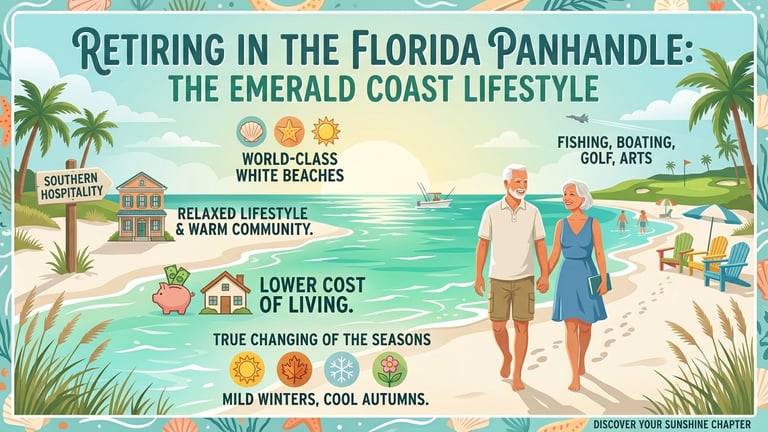
☀️ Ready to take the next step toward the Sunshine State?
Reading articles is a great start, but packing up your life and moving to Florida requires a real roadmap. In my book, "The Florida Retirement Guide," I pull back the curtain on the actual costs, tax strategies, and regional realities you need to know to avoid expensive mistakes.
Plus, as a reader, you’ll get exclusive access to our online portal filled with downloadable planning charts, cost-of-living graphs, and moving timelines to make your transition smooth and stress-free.
© 2026 The Florida Retirement Guide
Unbiased Relocation Data
The Florida Retirement Guide
Helping you decide where and when to retire in Florida.