Southeast Florida Local Guide
Miami, Fort Lauderdale, West Palm Beach, and the communities in between — what it's actually like to live here.
For residents and long-term visitors, not people on a one-week vacation.
Miami-Dade · Broward · Palm Beach • Real talk on costs • Local culture • Where locals actually go
The Vibe
Southeast Florida is a different country from the rest of the state — and locals say this without exaggeration. The tri-county region of Miami-Dade, Broward, and Palm Beach is the most densely populated, most expensive, most culturally complex, and most internationally connected part of Florida. Miami is a global city that happens to be in Florida. Fort Lauderdale is a city that has quietly reinvented itself from a spring break destination into a genuinely livable metro. West Palm Beach has an arts and dining scene that punches well above its size. None of this is what the postcards show.
Miami-Dade
Little Havana — Miami
Vibe: Cuban soul, authentic, rapidly gentrifying
The historic heart of Miami's Cuban exile community. Calle Ocho (SW 8th Street) is the main artery — domino players at Maximo Gomez Park, ventanitas (walk-up windows) serving café cubano, murals on every block. Viernes Culturales (Cultural Fridays) is a monthly street festival that remains genuinely local. Go before the gentrification completes.
Wynwood — Miami
Vibe: Art district turned tourist attraction
The famous murals are real and worth seeing. Wynwood Walls is the anchor. But the neighborhood has become very touristy on weekends — go on a Tuesday evening for a more local experience. The galleries, breweries, and restaurants are still legitimately good. The real creative energy has drifted north to Little Haiti and Allapattah.
Coconut Grove — Miami
Vibe: Old Miami, bohemian, waterfront
Miami's oldest neighborhood. Banyan trees, bayfront parks, a marina, and a walkable village center. The Barnacle Historic State Park preserves the oldest house in Miami-Dade. CocoWalk was recently renovated. A slower, more residential energy than the rest of Miami.
Coral Gables — Miami
Vibe: Mediterranean architecture, old money, excellent food
A planned city from the 1920s with Spanish Mediterranean architecture, strict building codes, and one of the best dining and shopping streets in Florida (Miracle Mile and Giralda Avenue). The Biltmore Hotel and Venetian Pool are genuine landmarks. University of Miami anchors the south end.
Brickell — Miami
Vibe: Manhattan-on-the-bay, finance, high-rises
Miami's financial district and the densest urban neighborhood in Florida. Brickell City Centre is the retail anchor. The Metromover is free and connects the area to downtown. Young finance professionals and Latin American business travelers dominate the demographic. High cost of living; most walkable part of Miami.
Little Haiti / Little River — Miami
Vibe: Authentic, creative, changing fast
The Haitian-American community's cultural center, and increasingly the home of Miami's working artists and creatives as rents push them out of Wynwood. The Little Haiti Cultural Complex hosts performance and visual arts. Iron Side and the Little River neighborhood just north are where the next wave of interesting Miami is happening.
South Beach — Miami Beach
Vibe: Art Deco, iconic, tourist-heavy
The Art Deco Historic District is genuinely stunning architecture — the largest collection of Art Deco buildings in the world. Ocean Drive is a tourist corridor; Lincoln Road is more mixed. Locals go to South Beach for the beach and Architecture, then eat elsewhere. The nightlife is real but expensive. Living here is a lifestyle choice with a serious cost premium.
Design District / Midtown — Miami
Vibe: Luxury retail, architecture, galleries
The Design District is Miami's luxury retail epicenter — Hermès, Louis Vuitton, Cartier — housed in architecturally interesting buildings. The Institute of Contemporary Art (ICA) is free and excellent. Midtown just south has more accessible restaurants and a local feel.
Broward County
Las Olas / Downtown Fort Lauderdale
Vibe: Riverfront, dining, walkable
Las Olas Boulevard is Fort Lauderdale's main dining and shopping street — genuinely pleasant, not touristy in the way Miami can be. The New River runs through downtown and water taxis connect it to the beach. Fort Lauderdale has made significant downtown investments and the result is a walkable, livable urban core.
Wilton Manors
Vibe: LGBTQ+ community, inclusive, neighborhood feel
One of the most LGBTQ+-friendly cities in the country — second only to West Hollywood in percentage of same-sex households. Wilton Drive is the main strip with restaurants, bars, and shops. A genuine community with a neighborhood feel that is rare in South Florida.
Hollywood / Hallandale Beach
Vibe: Laid-back beach town between two metros
Hollywood sits between Fort Lauderdale and Miami and has a relaxed, slightly retro beach town character. The Hollywood Broadwalk (a wide path along the beach) is excellent for cycling and walking. Hallandale Beach has a large Brazilian and Russian community and exceptional international dining. More affordable than its northern and southern neighbors.
Palm Beach County
Downtown West Palm Beach / Clematis Street
Vibe: Growing arts scene, nightlife, approachable
Clematis Street is the entertainment corridor — bars, restaurants, and live music. The Norton Museum of Art is world-class. The Kravis Center for the Performing Arts hosts major touring productions. West Palm is undergoing significant development and has genuine momentum as a livable downtown.
Palm Beach (the island)
Vibe: Billionaire enclave, Worth Avenue, manicured
The island of Palm Beach is one of the wealthiest zip codes in the country. Worth Avenue is the luxury shopping street. The Henry Flagler Museum (Whitehall) is an extraordinary Gilded Age mansion. Public beaches here are among the cleanest and least crowded in the region. Most people admire it; few can afford to live there.
Lake Worth Beach / Delray Beach
Vibe: Artsy, walkable, Atlantic Avenue scene
Delray Beach's Atlantic Avenue is one of the most pleasant walking streets in South Florida — great restaurants, local shops, and direct beach access. Lake Worth Beach next door has a scrappier arts community and more affordable living. Both are worth knowing as alternatives to the Palm Beach price point.
Cost Realities
Southeast Florida is the most expensive region in the state, and since 2020 it has become genuinely unaffordable for many people at middle incomes. The numbers below are not alarming — they are honest.
Key Numbers
Rent (1BR) — Miami-Dade: $2,000–$3,200/mo
Brickell and South Beach push higher. Little Havana, Hialeah, and North Miami are the relative bargains. Expect $2,400+ in any walkable area.
Rent (1BR) — Broward: $1,700–$2,400/mo
Fort Lauderdale proper. Hollywood and Pompano Beach are cheaper. Wilton Manors runs at a slight premium.
Rent (1BR) — Palm Beach County: $1,800–$2,800/mo
West Palm and Boca Raton vary widely. Delray Beach and Lake Worth are the relative values in the county.
Groceries: 10–15% above national average
Cost of living premium is real. Publix is everywhere. Winn-Dixie for budget. Whole Foods and Trader Joe's in most major areas. Latin supermarkets (Sedano's, Presidente) are often excellent and cheaper.
Dining out: $16–25 for a casual lunch in Miami
Miami is expensive to eat out. Fort Lauderdale and West Palm are slightly more forgiving. The best food values are in immigrant-community restaurants — Cuban, Haitian, Colombian, Brazilian — which are also often the best food, period.
Gas: Near or slightly above national average
Traffic is so bad that gas consumption is higher than it would be elsewhere. Many commuters report 45–90 minute one-way commutes as normal.
Electric bill: $140–280/month
FPL (Florida Power & Light) serves most of the region. A/C runs 10–11 months. Utility costs here are among the highest in Florida.
Parking: $150–400/month in Miami
If you live in a building without included parking, add this to your rent calculation. Street parking in Brickell and South Beach is essentially unavailable.
The Hard Truths
Miami is now genuinely expensive
Post-2020 migration from New York, California, and internationally has driven prices to levels that have displaced many longtime residents. Miami-Dade median rent is now comparable to mid-tier New York City neighborhoods. The no-income-tax benefit is real but does not fully offset the housing cost for people earning under $100K.
Insurance is a crisis
Florida's property insurance market has been in crisis since 2022, with multiple insurers leaving the state. Homeowners in South Florida are paying $5,000–15,000/year or more for property insurance — sometimes higher than their mortgage. Citizens Property Insurance (the state insurer of last resort) has become the largest insurer in Florida by necessity. This is not a small issue; it is reshaping who can afford to own here.
Condo special assessments
Following the 2021 Surfside condo collapse, new Florida law requires condominium associations to complete structural reserve studies and fund reserves. Many older condo buildings are levying significant special assessments — sometimes $50,000–200,000+ per unit — for deferred maintenance. If you are buying a condo in Southeast Florida, get the financials and reserve study reviewed carefully before closing.
Traffic is a real cost
I-95 and I-595 are among the most congested roads in the US. A seemingly short commute of 15 miles can take 60–90 minutes at peak. Many locals build their entire life around avoiding I-95 at rush hour. Factor commute time as a genuine quality-of-life and financial cost.
The no-income-tax advantage
Florida has no state income tax. For high earners relocating from New York, New Jersey, California, or Illinois, this is a significant and meaningful benefit that can offset much of the higher housing cost. For middle-income earners, the math is less favorable.
Weather - The Honest Version
South Florida has a true tropical climate — the only part of the continental US that does. Two seasons, not four.
Nov – Apr: Dry Season (65–82°F)
This is why people move here. Low humidity, warm but not brutal, essentially no rain for weeks at a time. Peak season for tourism, snowbirds, and outdoor everything. Winter in South Florida is genuinely paradise — clear skies, low humidity, and perfect temperatures. The tradeoff is that everything is more crowded and more expensive.
May – Oct: Wet Season (85–95°F)
Hot, humid, and rainy. Afternoon thunderstorms most days, sometimes severe. The Atlantic hurricane season runs June through November, with peak activity August through October. Humidity is oppressive from June onward — heat index values of 100–110°F are common. Locals develop rituals: morning beach walks, midday indoors, outdoor activity resumes after 6pm.
Hurricane risk in Southeast Florida is real but different from Tampa Bay. The Atlantic coast faces a different storm track. Miami has not taken a direct major hurricane hit since 1992 (Hurricane Andrew devastated Homestead). But preparation is not optional — know your evacuation zone, have supplies, and have a plan. Insurance requirements reflect this risk.
One genuine upside: South Florida's winter is objectively one of the most pleasant climates on Earth. December through February here is warm, sunny, dry, and beautiful. People who endure the summer feel they've earned it.
Daily Conveniences
Groceries & Markets
Publix
Present everywhere, reliably good. The premium option by South Florida standards. Many locations have full sushi bars and hot food stations.
Sedano's Supermarkets
The largest Hispanic-owned supermarket chain in the US, headquartered in Hialeah. Exceptional Cuban and Latin products, competitive prices, and excellent prepared food. If you live anywhere near a Sedano's, it becomes your primary market quickly.
Presidente Supermarket
Another Latin supermarket chain with outstanding produce, meat, and imported Caribbean and Latin American products. Often the best prices in the area for fresh goods.
Aldi / Winn-Dixie / Save-A-Lot
Budget options throughout the region. Aldi has expanded significantly and offers the best value for dry goods and basics.
Laurenzo's / The Boys Farmers Market — North Miami
A legendary South Florida institution for produce, seafood, and specialty items. The kind of place where local chefs shop. If you can get there, it's worth it.
Getting Around
Southeast Florida has the worst traffic in the state and among the worst in the US. Planning your life around this is not optional.
• Tri-Rail connects Miami, Fort Lauderdale, and West Palm Beach by commuter rail — slow but genuinely useful for the corridor.
• Miami-Dade's Metrorail and Metromover (free downtown loop) are useful within Miami. Coverage is limited but what exists works.
• Brightline high-speed rail now connects Miami to Fort Lauderdale, West Palm Beach, and Orlando — genuinely fast and worth using for trips between cities.
• Broward County Transit and Palm Tran cover their respective counties but are not efficient for most commuters.
• Ride-share (Uber/Lyft) is abundant and often the best option for short urban trips, especially in Miami where parking is brutal.
• I-95 Express Lanes use dynamic tolling — sometimes worth it, always faster than general purpose during rush hour.
• SunPass is essential. Tolls are everywhere. Without it you'll get invoiced at a premium.
Healthcare
The region has world-class healthcare infrastructure. Jackson Memorial Hospital in Miami is a major academic medical center and Level I trauma facility. Sylvester Comprehensive Cancer Center at UM is nationally ranked. Cleveland Clinic Florida in Weston and Boca Raton is excellent. Memorial Healthcare System in Broward is consistently rated among the best in the country. Baptist Health South Florida is the dominant private system throughout the tri-county area.
Banking & Finance
Miami is the de facto banking capital of Latin America. Many major Latin American and international banks have US headquarters here. For newcomers from outside the region, this means Spanish is often the primary language in financial service environments in Miami-Dade. This is not a complaint — it's useful context for what the culture actually is.
Local Eats Worth Knowing
South Florida has one of the most diverse and accomplished food scenes in the country. The Cuban, Haitian, Colombian, Venezuelan, Peruvian, and Brazilian communities have each built extraordinary culinary traditions here. The best food is almost never where the tourists are.
Miami — Local Institutions
Versailles Restaurant — Little Havana
Cuban · $ · open late
The most famous Cuban restaurant in Miami, and it deserves it. The Cuban sandwich, ropa vieja, and cortadito are the moves. Political conversations happen at the tables and the media shows up during every major Cuba-related news cycle. Go for breakfast or late night.
Lung Yai Thai Tapas — Brickell
Thai · $$ · genuinely excellent
Consistently one of the best Thai restaurants in the Southeast. The nam prik ong and boat noodles are exceptional. Small space, can get crowded. Worth any wait.
KYU — Wynwood
Asian-inspired wood-fire · $$$ · make a reservation
Wood-fire cooking meets Asian flavors in a beautiful Wynwood space. The roasted cauliflower, Korean fried chicken, and beef short rib are regularly cited as among the best dishes in Miami. One of the city's genuinely must-visit restaurants.
Cvi.che 105 — Downtown Miami
Peruvian · $$ · lunch gem
Miami has a large Peruvian community and exceptional Peruvian restaurants. Cvi.che 105 is the most accessible entry point — the leche de tigre, causas, and tiraditos are extraordinary. The lunch specials are one of the best food values in downtown Miami.
Mignonette — Edgewater
Oysters / seafood · $$
A neighborhood oyster bar that became a Miami institution. Excellent raw bar, well-curated wine list, and a room that feels like something out of a different city. Locals love it precisely because it doesn't feel like Miami.
Enriqueta's Sandwich Shop — Wynwood/Edgewater
Cuban · $ · cash only · breakfast/lunch
An old-school Cuban counter that somehow survived the Wynwood transformation. Café con leche, Cuban toast, and a cortadito at the counter surrounded by construction workers and gallery owners. Open 6am–3pm. Cash only. Get here early.
Fort Lauderdale
Steak 954 — Fort Lauderdale Beach
Steakhouse / seafood · $$$$ · waterfront
Consistently excellent upscale dining with an ocean view. The wagyu and local fish preparations are both exceptional. For a special-occasion meal in Fort Lauderdale, this is the benchmark.
Coconuts — Fort Lauderdale
Seafood · $$ · waterfront institution
A beloved waterfront seafood spot with a dock you can pull a boat up to. Cold beer, fresh fish, and a sun-soaked Florida-casual setting that feels authentically Fort Lauderdale. Not fancy; very good.
Louie Bossi's Ristorante — Las Olas
Italian · $$ · lively
Handmade pasta, wood-fired pizza, and an excellent cocktail program on Las Olas. Consistently one of the best Italian restaurants in Broward County. Go for happy hour at the bar.
Casablanca Cafe — Fort Lauderdale Beach
Mediterranean · $$ · historic building
Set in a 1920s mansion perched on the beach — genuinely one of the most atmospheric settings in Fort Lauderdale. The food is good but the location is exceptional. Go at sunset.
West Palm Beach / Palm Beach County
Marcello's La Sirena — West Palm Beach
Italian · $$$ · neighborhood institution
Family-owned for decades, Marcello's is the kind of Italian restaurant that locals celebrate anniversaries at and take visiting parents to. Classic preparations done beautifully, excellent wine list, warm service.
Hullabaloo — Downtown West Palm
New American · $$ · Clematis Street
A local favorite on Clematis with a rotating seasonal menu, excellent burger, and one of the best craft cocktail programs in the county. The patio is ideal in cool weather.
Café Boulud — Palm Beach
French · $$$$ · Daniel Boulud's Florida outpost
Inside the Brazilian Court Hotel on the island of Palm Beach. Daniel Boulud's culinary excellence in a gorgeous setting. For a true splurge meal in Palm Beach County, this is the top of the list.
Subculture Coffee — multiple locations
Coffee · $ · a local institution
The definitive independent coffee chain of Palm Beach County. Exceptional espresso, great pastries, and locations in downtown West Palm, Lake Worth, and beyond. The antidote to Starbucks.
The single best food value in Southeast Florida: Colombian, Venezuelan, and Peruvian lunch specials in the business-district areas of Doral, Sweetwater, and along Biscayne Boulevard. A full meal with soup, main, and drink for $10–14. These are also often the most delicious meals in the region.
The Fun Stuff (Locals' Edition)
Southeast Florida rewards the curious. Beyond the beach, there is world-class art, extraordinary nature, and cultural experiences found nowhere else in the country.
Vizcaya Museum & Gardens — Coconut Grove
Ticketed · one of Florida's most extraordinary places
A 1916 Italian Renaissance villa on Biscayne Bay, built by industrialist James Deering. The house is a museum of European decorative arts; the gardens are a formal masterpiece. One of the most beautiful places in Florida and consistently undervisited by locals. Don't miss it.
Art Basel Miami Beach — December
Ticketed + free events · annual · world's premier art fair
The most important contemporary art fair in the Western Hemisphere, held every December in Miami Beach. Beyond the main fair, satellite fairs (Untitled, Nada, Scope), gallery openings, and free outdoor installations take over the entire city. Much of it is free and accessible. This is Miami's cultural Super Bowl.
The Everglades
Day trip from Miami · Everglades National Park
The largest subtropical wilderness in the US is 45 minutes from Miami. Airboat tours in the northern Everglades are accessible and fun. Everglades National Park's main entrance at Homestead offers hiking, kayaking, and wildlife viewing. The Anhinga Trail is the single best wildlife-watching walk in Florida — guaranteed alligators, anhingas, herons, and turtles in a short loop.
Wynwood Walls — Miami
Free to view · world-class street art
The open-air museum of large-scale murals that put Wynwood on the global map. New works are commissioned regularly. Visit during the day on a weekday for the best experience and photos. The surrounding blocks extend the gallery outdoors for several more blocks.
Norton Museum of Art — West Palm Beach
Ticketed · world-class collection
An exceptional art museum with significant holdings in American, European, Chinese, and contemporary art. The Renzo Piano-designed expansion added significant space and light. One of the best museums in Florida and consistently underrated nationally.
Morikami Museum & Japanese Gardens — Delray Beach
Ticketed · unique in Florida
A Japanese museum and authentic bonsai and strolling gardens in Delray Beach — the result of a Japanese farming community that settled here in the early 1900s. Genuinely beautiful and completely unexpected. The Cornell Cafe inside serves excellent Japanese food.
South Beach Architecture Walk
Free · self-guided
The Art Deco Historic District between 5th and 15th Streets along Ocean Drive and Collins Avenue is the largest collection of Art Deco architecture in the world. Walk it early morning before the crowds. The Miami Design Preservation League offers guided walking tours.
Flamingo Park / Crandon Park — Miami-Dade
Free / small fee
Crandon Park on Key Biscayne is one of the best urban beaches in the US — wide, clean, and backed by a county park with picnic areas and trails. Less crowded than South Beach on weekends. Flamingo Park in Miami Beach is a beloved neighborhood green space with pools, tennis, and baseball.
Las Olas Riverfront / Fort Lauderdale Water Taxi
Small fee · scenic
Fort Lauderdale is called the Venice of America for its 165 miles of canals. The Water Taxi network connects the beach, Las Olas, Riverwalk, and various waterfront restaurants. A genuinely enjoyable way to spend an afternoon and see the city from the water.
Green Cay Wetlands / Wakodahatchee Wetlands — Delray Beach
Free · extraordinary wildlife
Two boardwalk-over-water nature preserves in suburban Delray Beach that offer some of the best wading bird photography in the world. Purple gallinules, anhingas, herons, spoonbills, and alligators at close range. Extraordinary on a weekday morning. Among the most underrated wildlife experiences in Florida.
Things No Tourist Brochure Will Tell You
Miami is a Spanish-speaking city
Miami-Dade County is majority Hispanic, and in many neighborhoods and business contexts, Spanish is the primary language. This is not a criticism — it is one of the things that makes Miami genuinely unlike anywhere else in the country. Newcomers who embrace it find a richer experience. Learning even basic Spanish opens doors and earns real goodwill.
The three counties are very different
Miami-Dade is a global city with a Latin American identity. Broward is more suburban, more diverse in the African-American and Caribbean sense, and culturally closer to New York than to Miami. Palm Beach County skews older, wealthier, and more politically conservative in many areas. Do not assume they are interchangeable.
Traffic will reshape your life
This is not hyperbole. Southeast Florida traffic — especially on I-95 between Miami and Fort Lauderdale — is among the worst in the US. People structure their entire lives to avoid peak commute times. If you can live close to where you work, do it. The time cost of a long commute here is enormous.
The Brightline changes everything for intercity travel
The Brightline high-speed rail connecting Miami, Fort Lauderdale, West Palm Beach, and now Orlando is a genuine game-changer. For trips between these cities, it is often faster than driving and far more pleasant. Locals with Brightline Select passes treat it like a commuter option.
The cultural calendar peaks December through April
Art Basel, the Coconut Grove Arts Festival, Ultra Music Festival, the South Beach Wine & Food Festival, the Fort Lauderdale International Boat Show, and dozens of other major events cluster in the dry season. This is the region at its most alive — and most crowded and expensive. Plan ahead for accommodations.
Haitian culture is a pillar of South Florida
Miami is home to one of the largest Haitian diaspora communities in the world. Little Haiti is the cultural center, but Haitian-American culture, food (griot, accra, pate kòd), music (kompa), and community institutions are woven throughout Miami-Dade and Broward. This community's contribution to South Florida is profound and underrecognized.
The Keys are close and worth it
The Florida Keys begin 45 minutes south of Miami. Key Largo, Islamorada, Marathon, and Key West are all accessible for day trips or weekends. The Overseas Highway is one of the most spectacular drives in the US. John Pennekamp Coral Reef State Park in Key Largo offers the best snorkeling in the continental US.
Snowbird season is real and affects daily life
Population in Southeast Florida swells dramatically from December through April as northern retirees return. Restaurants are busier, wait times longer, and traffic noticeably heavier. Locals often find May and June — before summer heat peaks — to be the sweetest spot: snowbirds gone, summer crowds not yet arrived, prices lower.
The condo building age matters enormously now
Post-Surfside, Florida law requires older condo buildings (40+ years) to undergo structural inspections and fully fund reserves. Many buildings are discovering deferred maintenance that is very expensive to correct. Before buying or renting in an older building, ask about the reserve study, any special assessments, and the building's inspection status. This is not optional due diligence.
Biscayne Bay and the intracoastal are part of daily life
For people who live on or near the water — which includes much of Miami Beach, Fort Lauderdale, and Palm Beach — life genuinely revolves around the waterway. Boating, paddleboarding, fishing, and waterfront restaurants with dock access are everyday features, not vacation activities. This is one of the genuinely special things about Southeast Florida that the rest of the country doesn't fully appreciate.
Southeast Florida Local Guide
Miami-Dade · Broward · Palm Beach
For residents and long-term visitors
Always verify hours and prices before visiting
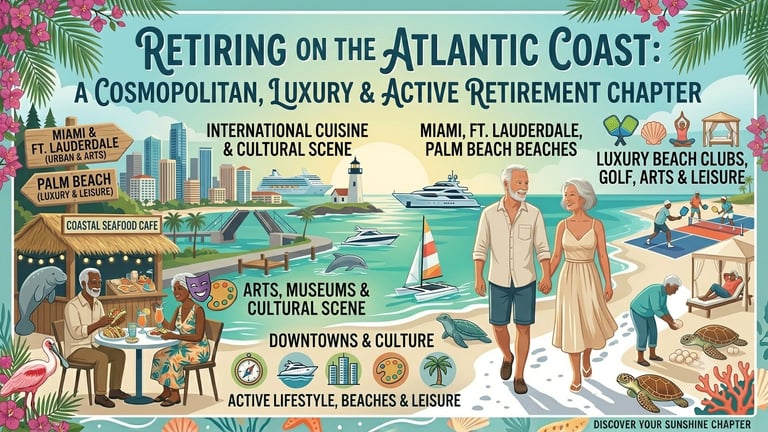
The Atlantic Coast (Southeast Florida)
☀️ Ready to take the next step toward the Sunshine State?
Reading articles is a great start, but packing up your life and moving to Florida requires a real roadmap. In my book, "The Florida Retirement Guide," I pull back the curtain on the actual costs, tax strategies, and regional realities you need to know to avoid expensive mistakes.
Plus, as a reader, you’ll get exclusive access to our online portal filled with downloadable planning charts, cost-of-living graphs, and moving timelines to make your transition smooth and stress-free.
© 2026 The Florida Retirement Guide
Unbiased Relocation Data
The Florida Retirement Guide
Helping you decide where and when to retire in Florida.